
With my feet upon the ground I lose myself
Between the sounds and open wide to suck it in
I feel it move across my skin
I'm reaching up and reaching out
I'm reaching for the random or whatever will bewilder me
Whatever will bewilder me
And following our will and wind we may just go where no one's been
Maynard James Keenan, Lateralus
Timetronomes
The darkness throbbed in sync with the vibrations of the quartz crystal. Along with it pulsed a frisky child’s mind. On nights of early awakenings, when one had to be on time for the tour bus, the wall clock in the child’s room played the kettledrum opening from the third part of Mahler’s first. The furniture and the gentlest of breezes behind the window accompanied this rhythm with parts of the contrabass and bassoon – the Brother John in minor. Franz Schubert wrote Winterreise. My room in a duet with the night wrote Reisefieber.
I recalled those concerts while falling asleep and waking up in La Florida, a secluded valley near the western coast of Costa Rica. The jungle surrounding La Florida strikes a complex polyrhythm, like the clock in a child’s room. The half-second hands tremble with the wings of insects, the second hands rise with the trills of a thousand bird species, and the minute hands bounce with thunders from the walls of the valley. The snaps of the branches, heavy with verdant abundance, keep track of the quarters of an hour. The dawns and sunsets, in the year-round equinox, are announced by the howlers.
The intensity of these sounds matches the cacophony of the urban jungle, but – just like among the concrete – they enter the consciousness only if our attention allows. The wilderness fell silent at my slightest suspicion that a hormiga bala, an ant with bites like pistol shots, had slipped into the tent. It is not surprising that we ignore this sound background most of the time. If our minds evolved tens of millions of years ago in the skulls of some small, arboreal primates, then the soundtrack I heard in La Florida has been shaping the mechanisms of our perception since the dawn of time1.
Dawn
In La Florida, howler monkeys have taken on the role of roosters2. A few years ago, on the Costa Rican Osa Peninsula, with howlers just above my head, I opened my eyes with a mix of fear and fascination. In La Florida, monkeys wailed from the distance, allowing me hear the howling with greater tonal resolution. The roar was initiated by one individual, almost immediately drawing the entire group with it. After a few bursts, the howlers would fall silent, waiting to announce the end of the day in the evening. Their performances were short and fleeting, like the tropical sunrises and sunsets. What broke the symmetry of silence? What alarm clock woke the instigator of all the frenzy? And what for? Google’s tentacles reached up to my tent, but somehow, in the midst of that wilderness, I was ashamed to ask.

Dawn from my tent. Howlers in the background.
Guttural grunts of an invasive species called in for the first coffee and arepas. Pique, a dog of the gremlin breed, and Edwin, his faithful master and a vaquero by trade, walked across the La Florida hills to inspect their nearby ranch. Usually my black coffee had been well-brewed when Edwin’s white sombrero, glistening in the strong morning sun, disappeared among the hills.
Forenoon
After coffee, around 5:30, it was time to work. A time when the sound of the jungle was drowned out by the clatter of saws, hammers, and other tools. A few hours, a brief window of time, in which the sun had not yet reached its zenith. This is one of those things that you must to experience; reading an article in National Geographic or watching a video on YouTube won’t suffice. I can recite:

When the Sun’s rays fall at an angle, the number of photons per unit area is lower than when the Sun is perpendicular. Each photon carries a certain amount of energy, which is partly scattered as heat when it comes into contact with matter. Therefore, when more photons fall on a less inclined part of the Earth, more thermal energy is supplied per unit area. Additionally, the light on the less inclined side passes through a thinner layer of atmosphere, leading to less scattering.
yet nothing in my understanding of the physics of light and matter, nothing in the simple calculation of the difference in joules per square meter between La Florida and LA, brings me any closer to experiencing3 this difference.
Noon
Around noon, the world was becoming unbearable. The whir of tiny wings counted down the time of respite in the shade of the trees. Hummingbirds, just above my face, hung between reality and hallucination. The heavy air slowed their movement. I would swear I saw symbols of infinity drawn by their wings – the optimal shape to hang motionless in front of the chalice of a flower. The infinity, in the hallucinatory heat, emanated from the hummingbird wings, embracing everything around. An infinite number of atoms in the mineral structure of an infinite number of stones at the bottom of the stream, whose murmur – the movement of an infinite number of water particles – reached me from behind the hill through the trembling of an infinite number of air particles. And endless chitin chains in the abdomens of the insects hidden in the mirror of the jungle in front of me. A mirror for an infinite number of lush photons. All this gestalt from the endless ebb and flow of an infinite number of ions under my sweat-soaked hat. Ebb and flow, wave after wave, the jungle hums the eternal mantra. The ebb, the flow, the breath of time…
Afternoon
The hallucinations were usually interrupted by the Montezuma oropendola – a beautiful bird, resembling a toucan, but with a small beak. Every day, shortly after noon, it would perch atop a solitary tree and announce its presence with the most unusual singing. It filled the pauses written in the score for other birds. Later, wild turkeys would arrive, usually in pairs. They jumped from tree to tree helping themselves with the wings. True dinosaurs of canopies. A perfect example of a transition state between flightlessness and flight. A clumsy wing is better than none when hopping on branches.
The most unusual singing of Montezuma oropendola.
Evening
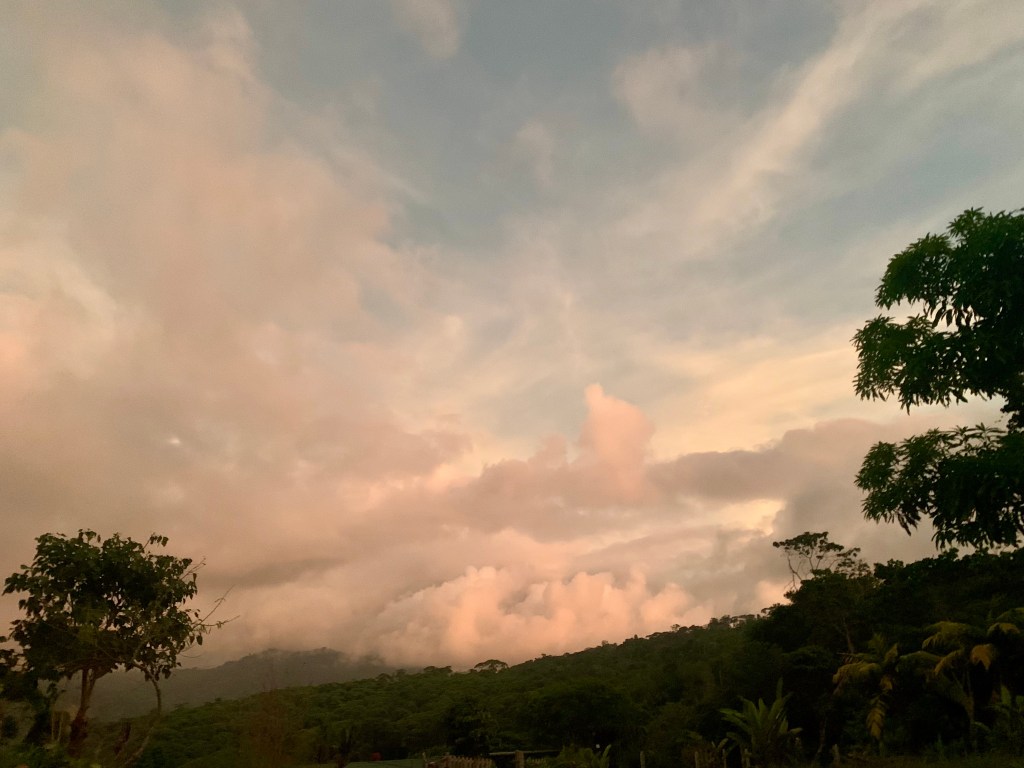
The evening was a time of thunder and cicadas. The tropical forest is a cloud factory. From early afternoon, the trees transpired. With their breaths held, they waited all night for the first light to open their stomata, to let the air in and let the water vapor out. Trees do not have hearts, and they “pump” water from the roots to the crown by evaporation. The ebb, the flow, the breath of time. At sunset, the clouds and the earth fell out with each other enough to discharge the tension with lightning and thunder. Together with the chirping of cicadas, the unearthly color of the sky was sending me to another planet. The sound cicadas made was not that different – in tone and intensity – from the sound of hacksaws cutting through the rebars. Whenever the cicadas started their sawing, I often wondered if they had eavesdropped on the construction site in the morning, and then presented their version to us.
The sound of dusk with a solo by a cicada.
Night
At night, the jungle still ticking with the tremble of insects. Depending on the rainfall, frogs joined this concert for thousands of crickets and the wind in the canopy. For some reason, this was the most annoying of the sounds. Not because of the hour, but because of its unpredictability. The frogs had no regard for regularity, croaking against any rhythm – drunken hands of the jungle clock. But it didn’t matter anymore. My mind, no longer that of a child, no longer frisky, intoxicated by life around me, drifted away almost instantly. Until next morning’s howler howl. The same one for thousands of years. The ebb, the flow, the breath of time.
Siddhartha listened. He was now nothing but a listener, completely concentrated on listening, completely empty, he felt that he had now finished learning to listen. Often before, he had heard all this, these many voices in the river, today it sounded new.
Hermann Hesse Siddhartha (translated by Susan Bernofsky)
1It is said anecdotally that one can find better focus in a cafe than in a library. My stay in the wild made me realize that silence is not normal. Our ancestors were constantly accompanied by a rhythmic, though not necessarily uniform, background. Lofi hip hop, the popular music genre among those wanting to focus, has something of a jungle sound.
2Giving credit to the roosters, they could also be heard from nearby farms, but their internal clock struck dawn around 2 am.
3This experience of experience reminded me of the knowledge argument and the famous problem of What Mary Didn’t Know.
 Third Woods