

I run through landscapes
Wrapping them in gold paper
Of inner symbols
For P.
Olbers’ Paradox
At the foot of Mount Whitney, embraced by the August night and timeless flames, we wait for the children of Perseus. We gaze eastward toward the Alabama Hills. For now, the only movement across the sky is the drifting satellites and sparks shooting from the campfire. Stars falling upwards. Our thoughts and words also drift and spark, yet somehow they find their mark. I try to trace their strange trajectories. How do we reach each other? How do we understand? I can hardly believe that once, the motion of stars occupied me more than these questions. In the moments of silence, hypnotized by the stillness of the sky, I begin to see nonexistent parallels. I try to reconcile the coldness of distant stars with the warmth of those close to me. Like a mad medieval mystic, I sketch a theory of human connection based on the celestial sphere.
Basic premises:
The firmament is a dark canvas for stars, and strangers are a blank canvas for us, a starless sky. Only points of light reach our eyes, and only shards of information about others reach us.
Getting to know someone is like the transition from day to night, with the slow emergence of the first stars. When we gaze long enough, more stars appear; when we are in the right place and time, we might glimpse the beauty of the Milky Way.
Olbers’ Paradox, which reveals the contradiction between the observed dark sky and the hypothesis that it should be ablaze with starlight, applies here as well. We may look at another person for a long time, but we will never see their full brilliance.
Like stars, the pieces of information about others are woven into constellations—arbitrary objects, metaphors filtered through our internal expectations. A desperate attempt to understand them better. In sketching others, we are like children connecting the numbers in a dot-to-dot drawing. The picture is recognizable, but still simple and angular.
From time to time, a falling star pierces through the canvas, causing chaos—it strikes deeper, leaving traces as intricate and beautiful as the paths of elementary particles in a cloud chamber.
My thoughts are interrupted by the first falling star. I’m not sure if it is the soft voice from my right or a rock burning up in the Earth’s atmosphere. There is something frivolous about falling stars. Yet, there is also weight—the weight of a wish. I remember my first wish when, as a child, I saw a streak across the sky: “I wish my brother could get up of his wheelchair”. I return to the present, amused by my naivety, and make no wish at all. Somewhere in the background, I hear a quiet “We’re just two lost souls swimming in a fish bowl, year after year, running over the same old ground, what have we found? The same old fears, wish you were here.” I imagine the Earth carrying our lost souls, drifting year after year through the Solar System, over the same old ground. The stars begin to fall in volleys, and I realize my eyes have been closed the entire time.
I lift my eyelids. The fire is dying down. Now embraced only by the night, we fade from each other’s sight, each on our own, into the darkness. I wrap myself in a cocoon of goose feathers still understanding nothing still. At least I will peacefully not sleep.
The Approach
I lift my eyelids. The constellations have shifted by a few hours. I don’t know if I slept, I don’t know if I dreamed. I creep through the darkness, careful not to wake the others. A bear caught in my flashlight does the same. We recognize ourselves, nocturnal creatures. I am ready!
I wake up again on a narrow rock shelf. I don’t know what I was pondering over the last hour. The Ebersbacher Ledges are not particularly challenging rock features, but people do die here, so it is good that I have woken up. The walls enclosing the gorge reflect the roar of the stream below. Darkness, inherently a visual entity, now takes on an auditory character. I am not moving through space, but through sound. The path widens, and I can finally start to run. A faint glow seeps from around a rock bend. I slow down to avoid colliding with the stranger ahead of me.
“It’s not my day,” says a voice from the darkness. I discern a face with the texture of a rock, a face eroded by time and experience. “I’ve climbed this way dozens of times, but today is not my day.” There is something unsettlingly familiar in his eyes. There is also a calming calmness. I wish him strength and move on. A few switchbacks later, it dawns on me that he had an Eastern European accent. Why didn’t I ask him where he was from? I consider turning back. Maybe it was me, decades from now?! For now, I am ageless. Every day is mine. My mind has not lost its clarity, my tendons their elasticity, my lungs their capacity, but maybe that was me? One day, a day will come that will not be mine.
After half an hour, I turn around and see a bright point of light moving toward me from below. “Maybe it is his day after all!” I think with joy. “Perhaps not mine,” I add a moment later. The vast granite slab I find myself on is crisscrossed with dozens of streams and patches of shrubs. I lose myself in this labyrinth. Branches cut into my skin. I stumble into water up to my waist. At least I wash away the streams of blood running down my shins. It is not the first time I’ve waded through thickets and icy streams, so I don’t panic.
The grayness begins to steadily replace the black. I can walk freely without a flashlight now. The sight, however, brings no comfort, as the path I finally found disappears into a massive, sandy slope that I will have to climb. A herd of deer bolts uphill. They wear grotesquely large tracking collars, stripping them of their deerlike dignity. I don’t know what they are doing so high up, but I draw a bit of energy from their leaps. Midway through the ascent, I start inventing excuses for turning back that I could present at the bottom. I crumple those thoughts like pages of failed drafts. Finally, I reach a plateau, crowned in the distance by the ridge of Mount Russell, my goal for today.
The Ridge and the Summit
Sometimes it’s good to pause. Running dozens of miles each week makes it easy to forget that. I sit down in the shade of a large boulder. To my left, I see the north face of Mount Whitney; to my right, Lake Tulainyo gleams in the morning sun. It’s one of the highest lakes in North America though the standards of the competition aren’t entirely clear. I read about it before, climbing Nevado de Toluca in Mexico. Laguna del Sol in Nevado’s crater competes with Tulainyo for a place on the podium. The sky is perfectly clear, but for a moment, memories return, and I see clouds drifting over the Mexican Nevado. For the first time in a long while, I’m not in a hurry. I inhale the moment along with the thin air.

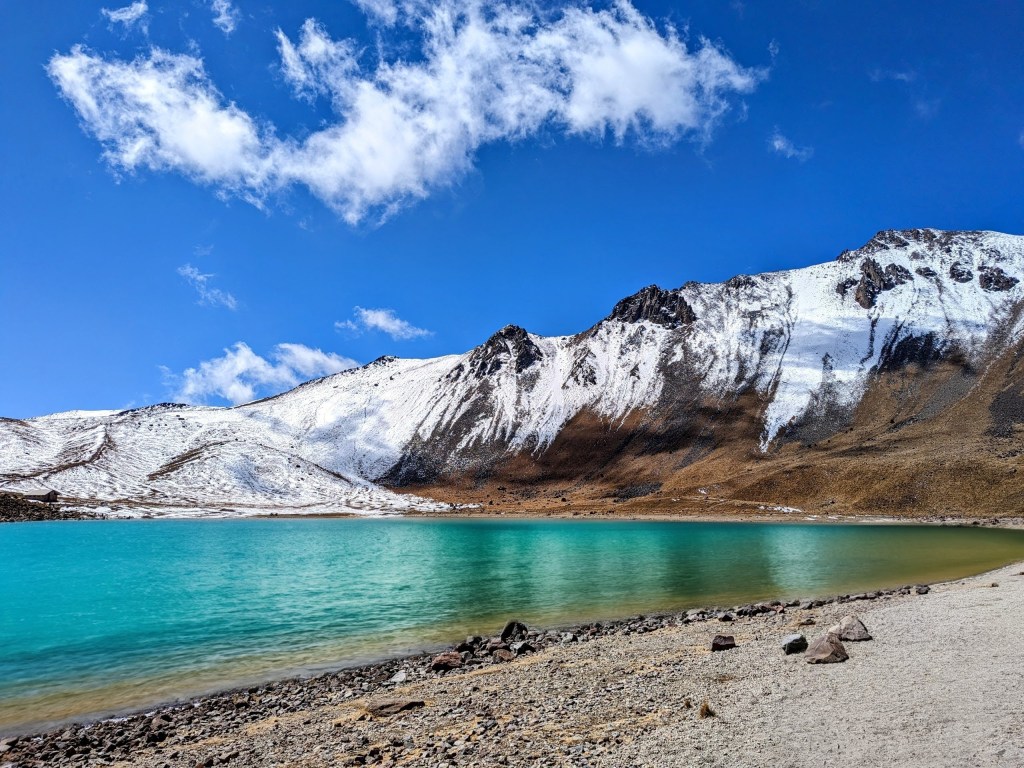
I don’t clearly remember how I reached the summit. The jagged ridge presents a challenge that is just enough to induce flow, that phenomenon where time passes differently—I feel no fatigue, I don’t feel myself; I am one with the rocks. I realize I’m at the summit just because there’s nowhere else to go. I stand on the edge. Across the valley, on Mount Whitney, tiny silhouettes of people shimmer into view. I receive a message that two of those tiny black dots are part of my group. A strange euphoria washes over me. I imagine their joy as well. I feel an invisible thread connecting the two peaks, linking us like stars in constellations. According to my absurd mystical theory, individual people are constellations of constellations. And when people connect through the invisible threads of shared feats, we create fractal constellations in endless recursions of the word “constellation.” What beautiful nonsense I’m rambling! Am I shielding myself from loneliness at the summit? Perhaps, but how happy I am! It’s time to descend.
The Descent
I plan to descend via the southern face. It’s the crux of the entire adventure. To reach the scree gully leading down to Iceberg Lake, I need to find a narrow chimney: several dozen meters of vertical, yet relatively safe, downclimbing. The focus strips away metaphors and any thoughts worth remembering. All I know is that I’m having a great time! At the bottom of the chimney, I look up. It’s hard to get used to how different perspectives are from above and below. I zigzag down the shifting scree. The large boulders offer a sense of stability, but I can feel some of them tremble under my weight. Finally, one gives way entirely, and I tumble down with it.
I lie on my back, covered in gravel and small stones. I chastise myself for my carelessness and assess the damage. Blood pours from my hands, and pain radiates from my tailbone. My helmet saved the back of my head. I’m shaking, brushing off all the metaphors. The thread of shared feats vanishes, the constellations disappear. It feels so pleasant to lie here with an empty mind. And although the situation is far from serious, it dawns on me that dying with an empty mind might be pleasant too. Time to get up! To stand, I need a metaphor! A song lyric comes to my aid: My body’s built much braver cause I once befriended you! And the rivets in my past continue moving me, like the bellows in bagpipes still blowing melody. Befriend—what a strange word in Polish it is. It contains ‘self’ and a double prefix that gives a sense of bringing something closer. Bring something close to oneself. My thoughts bring me the smile of a person from Whitney’s summit. Then I think of my mother’s voice. I’ll tell her this story tomorrow. I stand up lightly, brush off the dust, and head down, surfing nimbly on the sliding stones
The Drive Back
I reach the car first. I notice a slight disappointment—I guess I was hoping my friends would already be waiting for me. According to my calculations, they should be close. I change my shirt to greet them, but I don’t even finish buttoning it when they come running around the curve. I hug them spontaneously, mumbling something about the mental exhaustion after not seeing a living soul for a good while.
Without delay, we get into the car and start the drive back. We head down toward Alabama Hills. It’s daytime, so there are no falling stars. In a sudden realization, it hits me that there is no reason fragments of rock would not burn up entering the atmosphere during the day. Stars are falling constantly; I just can’t see them.
I don’t see the falling stars, but I hear them, just like the previous evening, from the right side. They pierce through one dark canvas into another. We drive through Alabama Hills, and suddenly, very clearly, Ella Fitzgerald sings:
I can’t forget the glamor, your eyes held a tender light
And stars fell on Alabama last night
For the first time, I find the courage to turn to my right. In another’s eyes, I discover the brightness of all the stars and the solution to Olbers’ Paradox. But after a moment, it hits me—it’s already day. During the day, we cannot see the stars. When the day comes, we must wake up.
And just before I do, I smell ginger, and I feel another hand putting something in mine.
 Third Woods