
zgonego (n.): the true disappearance of the self in a flow-like state — not just immersion, but an ego-death so complete that any realization comes only afterward. Unlike ordinary flow, in zgonego there is no “I feel good” or “I am in the zone,” because even a flicker of “I” would mean the ego still lurks nearby. Only when the task is done does memory return, vivid but slightly alien, as if it happened to no one at all.
(from Polish zgon (“death”) and English gone + ego)
Kinlochleven
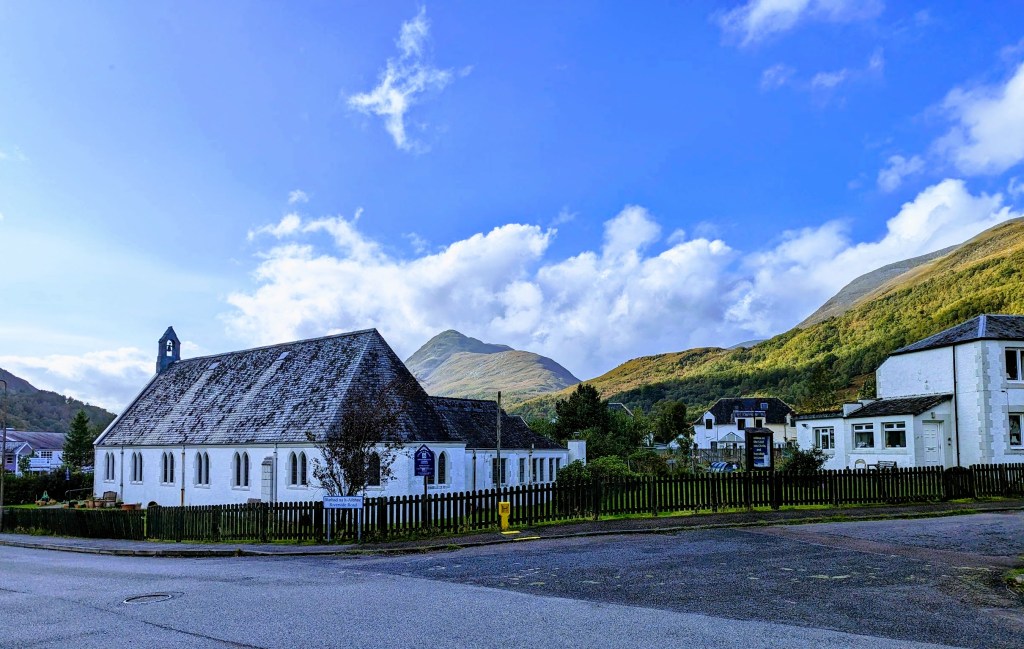
Very rarely, and always with great intensity, a thought comes to me — so blurry at its edges that it is more like a feeling — that I am experiencing a perfect moment, that everything seems exactly where it should be. I had this thought for the first time in Kinlochleven, a village hidden deep in the Scottish Highlands. Soaked through and exhausted after three days of hiking, I was resting with warm tea and a fresh scone on a bench at a bus stop. The morning light rejoiced in the early autumn blush of the surrounding peaks. The woman sitting next to me was telling me some story, clearly an entertaining one. I understood very little, lost in the tangle of a thick Scottish accent and her toothless lisp. “The content doesn’t matter if you can read happiness in a face,” I thought. A boy passing by in his school uniform bowed politely and said, “Good morning Mrs. Kinnaird, good morning Sir.” Mrs. Kinnaird burst into laughter as she commented on something. The boy giggled, shyly but genuinely.
Chiaroscuro, hotea, freshscone, gigglisp. Everything was exactly where — and what — it should be. Even the slightly too big school uniform. And a tear that found the ideal path down my cheek.
Auburn, dawn
Now I’m having a similar thought, though the circumstances could not be more different. I’m lying on the artificial turf of a stadium in the Californian town of Auburn. I open my third can of Canada Dry. The five a.m. air is pleasantly cool after a night spent in mountains baked by the day’s heat. Artificial grass and Canada Dry? The paths of perfect moments are unpredictable.
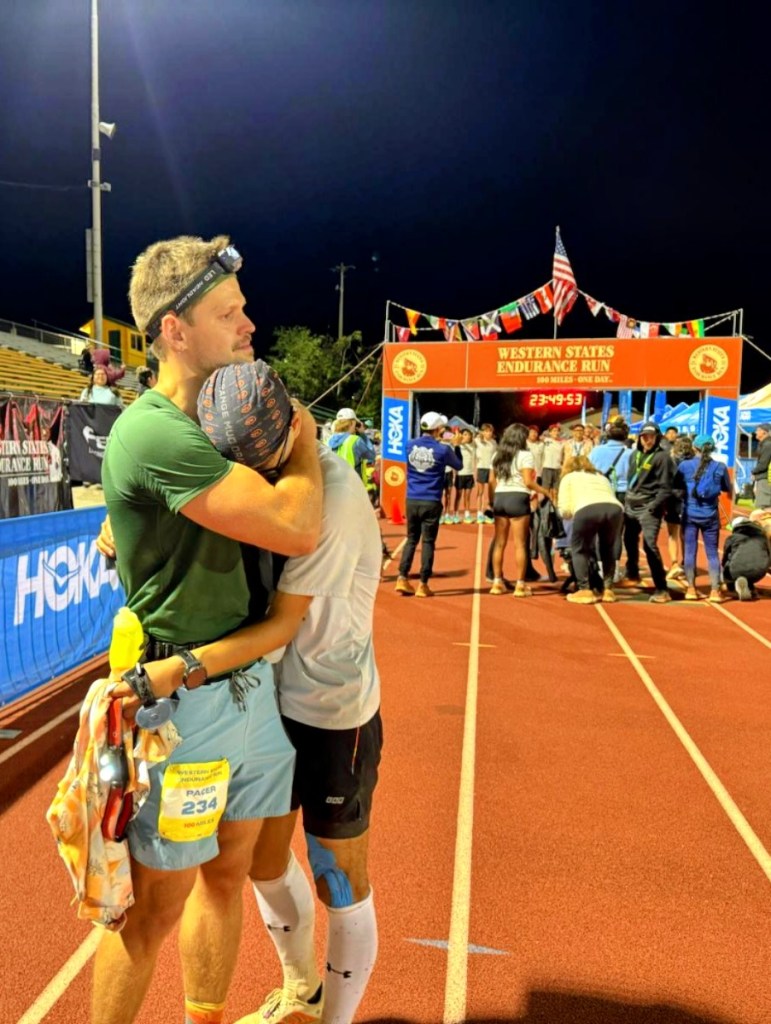
Every few minutes, a madman runs into the stadium. Immediately, a crowd of other madmen surrounds them. A roar goes up. The speakers spill fragments of their biography. The madman crosses the finish line. The clock above the field is still under the 24 hour mark. Somewhere inside me, a tiny charge of happiness detonates. I would never have guessed I carry so many of these within me. This madman is named Mike and he has just finished the hundred-mile Western States race in under twenty-four hours. For that, he’ll get the silver belt buckle — the dream of many ultrarunners. My friend, whom I paced on the trail, finished just a few minutes earlier. Seven hours ago, nothing suggested he was about to face such a brutal fight with pain and exhaustion. Seven hours ago, I hadn’t been aware of the silver buckle or the race against time that awaited us.
Auburn, a dusk before
Dusk is settling in, yet somewhere along the way it lost its usual companion, the chill. It’s still hot, but people around me are prepared for it. They wait for runners with buckets of ice, electrolytes, fresh clothes. Ice isn’t really needed, since here we have to cross the cold waters of the American River. Dozens of rescuers stand in the river for hours, guiding exhausted hundred-milers and pacers like me safely to the other side. Our job is to lead these runners through the final miles of darkness and technical terrain.
My friend arrives, well behind schedule, but does not look good. He’s battling stomach issues, a painful knee, blisters on his feet. He’s clearly sleep-deprived. I explain to the volunteers and medics that this isn’t my first time supporting him through such madness, and that he’ll bounce back soon. But time is ticking relentlessly, and I keep hearing about the silver buckle and the twenty-four hour cutoff. Finally, one of the volunteers pulls me aside and says firmly:
“You can be here as long as you need — our job is to help you. But our other job is to get you out of here as quickly as possible. You’re still on pace for that silver buckle. Your runner has a job to do, and your job is to get him through it safely before five a.m.”
There are people whose charisma I can’t quite define. Usually older men, upright posture, clear-eyed. Yes — I recognize them first by their bearing and gaze, only later by how they speak, how they act. They’re the kind of men Steinbeck hid in some of his characters. Take Slim from Of Mice and Men:
There was a gravity in his manner and a quiet so profound that all talk stopped when he spoke. His authority was so great that his word was taken on any subject, be it politics or love. This was Slim, the jerkline skinner. His hatchet face was ageless. He might have been thirty-five or fifty. His ear heard more than was said to him, and his slow speech had overtones not of thought, but of understanding beyond thought. His hands, large and lean, were as delicate in their action as those of a temple dancer.
Standing before me is Slim — a man you simply must listen to. His tone makes you stand at attention, though with a strange calm inside. Slim plants in me a sense of mission and responsibility. There is work to be done — I think — and I head towards my runner.
Auburn, dawn again
A cyclist, lit up like a Christmas tree, shouts “24 hours baby!!!” and I snap out of my trance. The past hours are wrapped in darkness, literal and figurative. The hundredth mile winds through the streets of Auburn. This town hasn’t slept tonight. It’s just before five a.m. and people are shouting at us from yards, cars, curbs. I try to place myself in time and space. Where was I? Where did I disappear to?
I think about this as I lie on the artificial grass, sipping my third Canada Dry. A sense of mission, responsibility, adrenaline and unwavering focus buried my “I” somewhere deep. A mantra lulled my ego into slumber: “Rock! Root! Rock! Careful! How’s the knee? Eat a gel! Root! Keep the pace! Rock! Next ibuprofen in twenty minutes! Root! We got this!” ad nauseam.
From the speakers comes another bio: she’s been fighting cancer for four years and dedicates this run to her six-month-old daughter! Another: Western States is hardly a challenge for him — ten years ago he walked the length of both Americas. Another: he fought in Iraq and Afghanistan, lost an arm there, now campaigns against war.
I lie on the artificial turf, surrounded by running stories — each one anchoring a body, each one proof they are human.
What is my story? For a moment, I feel as if I have none — and it’s a dangerous thought, giving me a glimpse of divinity. True gods are without history. The gods of our myths are no longer gods once they have a story; they become mortal. To live without a story — to linger in metaphorical darkness — is a state of apotheosis, in which the self dies. Maybe it’s no coincidence the god of the Old Testament says, “Let there be light.” Maybe the proper word for the death of the self and the achievement of a godlike state is apoptheosis — a play on apotheosis and apoptosis, the death of a cell. I mumble this thought, half-delirious from exhaustion.
I take a sip of Canada Dry. I brush against the artificial grass. This is a perfect moment. Of course I have a story. I wouldn’t trade it for anything. Giving up my own story would be a Faustian bargain — surrendering the very matter I am made of. Of course I have a story — and this is the last sentence of one of its chapters.
 Third Woods