
Stillness is not the opposite of movement
After Crying
The toddler cries himself hoarse. The cry cuts off—suddenly and mechanically, like a guitar string breaking—surprising him. The surprise breaks the tantrum. He stands up, swaying clumsily like the reeds in front of him, touches them, and grins wide. My inner I grins too, despite the sharp biting of an ant tangled in the hair on my calf. I study the ant, and the pain. It’s not dangerous, so why rush to end it? I couldn’t close my ears, so I let the toddler’s cry weave itself into the jungle, imagining it as another birdcall. I can’t close my pain receptors either, so I let the biting become just another background sensation.
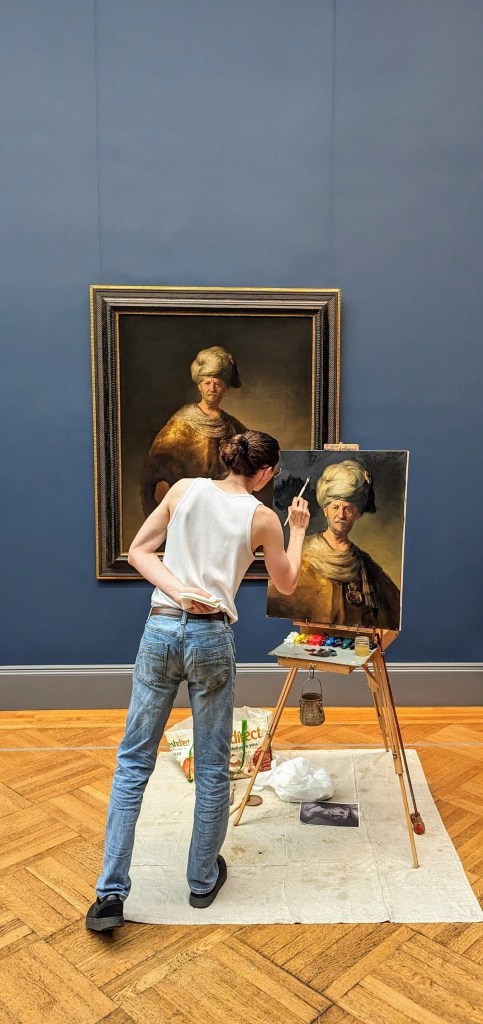
The boy’s grandfather scatters compost around newly planted trees. A yellow leaf falls from one planted decades ago by the wind. The dry season is coming. The leaf is falling, the ant is biting, the boy is touching the reeds, the compost is nourishing the soil. The whole moment is a painting— a bucolic, Arcadian scene. I varnish it and place it in my private gallery. Before I switch off the arcade lights, I glance at a couple other canvases. The next one draws me toward the shoreline.
Stray Dogs
A Filipina girl sits under a cliff. The scene is surreal because I’m in several spots at once. One me stands between her and the ocean, watching a pair of whimbrels probe the sand with their comically long beaks. Far on the horizon, two oil rigs probe the seabed with their drills. If I didn’t know better, I might mistake them for giant wading birds.
Another me digs a hole in the sand in front of her.
“Your skin burns against the grey rock,” I say.
“Did you just mean I’m brown?” she asks, half-joking, half-provocative.
“Your skin is almost gold,” she adds. “And you smell like iron and smoke.”
The waves break and scatter themselves into kaleidoscopic confetti.
Brown, gold, grey. I lift these hues onto a painter’s palette. Mine could be gold, hers dark caramel. Both could pass for mud, or compost. Colors exist in the context that holds them.
A third me stands aside, the palette in hand, capturing the scene in the style of Hopper. The title: Stray Dogs. All four of us are stray dogs, askal in Tagalog—rooted in the Spanish calle, street. The linguistic compost of colonization.
I step sideways in the gallery, and the light changes.
LA’s Meninas
A long, narrow, claustrophobic kitchen. A typical pregame party on the LA hills. Through the window, the skyline flickers. Foreground, midground, background—each crowded with figures. I catch my own reflection in a large pane at the far end, like the painter in Velázquez’s Las Meninas.
The girl in front of me has eyes like freshly cut, late-summer grass, and flowers inked on her arms—art within art, ornaments straight from an Alphonse Mucha poster. I study them too greedily. The pollen from the flowers is scattered in the sky. I can’t tell it apart from the stars. I look down to break the spell and find flowers embroidered on my socks. The whole canvas is in bloom. A short Brit in a green tracksuit with a pinkish face stands among us—a playful flourish from the painter. A personification of an Afghan snow leopard towers above as all. A troupe worth the painting.
I turn, and there it is again—the first canvas, waiting where I left it.
Markov God
The ant is still biting. Another yellow leaf is falling—or perhaps the same one.
Many paintings hang in the arcades of my cortex. I chose these three because they couldn’t be more different. Hung in a gallery, they’d belong to different styles, different eras. Yet each captures an event from the same life, which means there’s a smooth transition between them—as if the grains of pigment slowly rearranged themselves into a new image. Viewed in motion, the change is seamless. But how does it happen? Perhaps—this is only half-serious, in the spirit of a Borgesian game—it works like this:
The paintings in my gallery, the still frames, are connected in a chain in which each new frame depends only on the current one. In the background, an immense transition matrix governs each shift. A Russian man introduced this idea to mathematics more than a century ago. But maybe, deep down, it’s not just a calculation tool. We could imagine that matrix as god—not the bearded overseer of childhood catechism, but rows and columns of probabilities carrying us from frame to frame. Or perhaps not god at all, but a painter, who, by assigning probabilities, decides what colors fade, what figures migrate, what details stay. And in the bottom corner of each fixed canvas, the signature reads Markov.
Stillness is not the opposite of movement
 Third Woods