
Time does not really exist without
unrest; it doesn't exist for dumb
animals who are absolutely without
anxiety.
-Kierkegaard (who obviously didn't have a dog)
Among the many things that captured my childhood imagination was a question posed in a philosophy book I often perused: “What is uniquely human?” Of the few suggested answers, the concept of time and knots were the ones I returned to most often while wandering the woods near my home.
I quickly realized, watching the spring leaves budding and migrating birds returning, that time is central to the non-human world. That unlike the rest of nature, humans, with our heated homes and electric lights, might have actually blurred the concept of time rather than sharpen it. Maybe it’s the defiance of time that is uniquely human? (unless we want to get tangled in philosophical semantic games and hang ourselves on the word “concept”, but the “concept” of anything is uniquely human).
Knots were harder! Were they truly a uniquely human invention?
Now I see that the authors seemed a bit too pleased with themselves. “Knots” felt less like an answer than a stand-in for technology in general. But back then knots filled my head! I learned to tie my shoes around that time, and for a while I thought it was something uniquely ours, something that separated us from nature. I would stop ceremonially to tie my laces on the forest paths and look around with a sense of superiority. Children are silly! — and we don’t really grow less silly—we just stop noticing, with our adult noses held high. Later, I learned that some hagfish can form knots with their bodies to create leverage to tear pieces of flesh from their prey. But let’s leave knots for now and return to time.
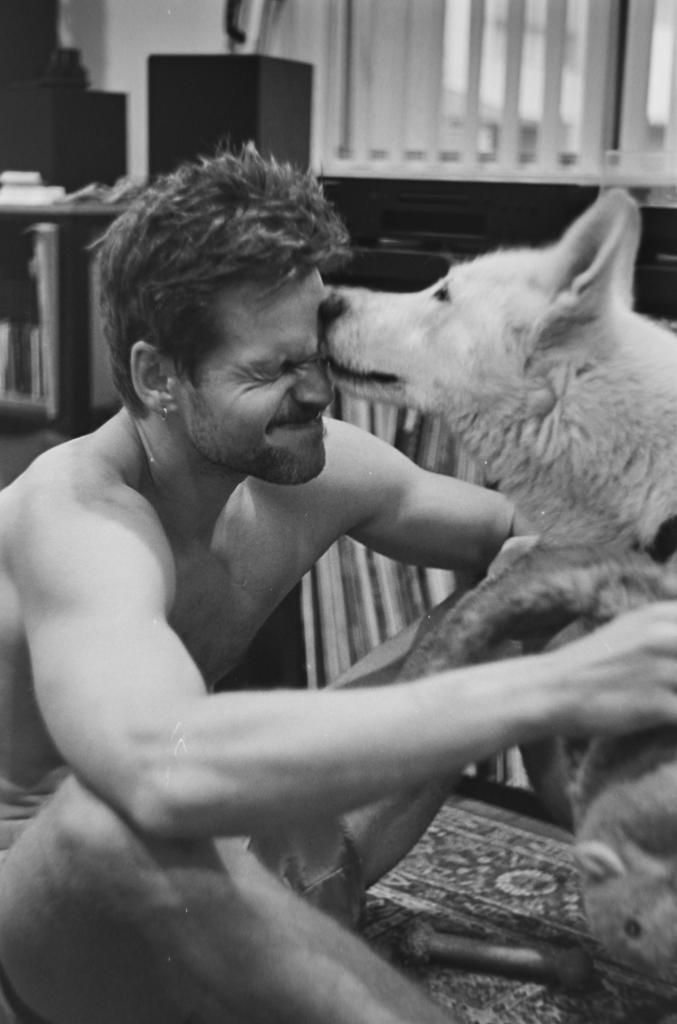
Recently, I was taking care of a couple of dogs, one young and one old, and I couldn’t help but think about their perception of time. Mario, the old one, with his spine curved like a bow ready to shoot his soul into canine heaven, seemed to be the most relaxed creature out there. He still showed excitement when I came to walk him, but never impatience. It reminded me of the elderly people I know—those whose daily rhythms are deeply carved into the fabric of time, yet somehow remain undisturbed when the bus is late or the line is long. Is it that with time, you essentially learn the ways of time? That rushing doesn’t bring us any closer to our destination? That all things end, and most never even begin?
Punch, the young one, seemed to be the opposite. He got anxious, wailing in tune with his husky genes, waiting for someone to arrive. Were his hours stretching into eternities? Like the hours when you text your crush and they haven’t replied yet, and each moment dilates into infinity, diverging from the actual passage of time (Einstein once said something about hot stoves and pretty girls in the same vein, though he probably never actually said it, so I won’t bother quoting).
Is the dog’s—and our—anxiety driven by some slow dopamine drip, our synapses working like hourglasses, molecule after molecule, grain after grain? How do those clocks tick? What’s the reference point, the cesium standard of internal time? What’s the quartz crystal of our minds, human and animal alike? I know there’s a whole body of research on that, but even that body is only scratching the surface. Maybe one day I’ll find the time to dig deeper. Tonight, though, my circadian clock, with its melatonin drip, chimed the call to sleep.
 Third Woods
[…] wrote once. Why didn’t I mention Argos? The faithful dog who waited for his master Odysseus for two decades, […]
LikeLike