
Is it rocks scattered among the chaparral, or chaparral among the rocks?
When faced with the monotony of a landscape, the brain seems to have a few options. (1) It can lose patience altogether and redirect attention elsewhere. Perhaps to that stain on my shoe, or the texture of the soil beneath me. (2) It can let the scene seep through the eyes but only as a blurred backdrop for unrelated thoughts. Or, finally, (3) it can take on an almost artistic endeavor: sculpting perception itself, sharpening contrasts, molding details, and sometimes transfiguring them into analogy.
I — that is, my brain — am in the third mode now. The menagerie of igneous, sedimentary, and metamorphic rocks at Gaviota State Park has turned into a stained-glass window. There’s something about their uneven, weathered hues that makes me feel as if faint light was shining through them — as if the rocks were translucent.
I often like to think that mountains and rocks are body parts of sleeping giants. Look there! A nose sticks out from the blanket of shrubs. When they wake, they’ll shake the plants like pollen dust and walk away, their strides carving valleys.
Today I imagine the mountains differently: as dwellings, and the rocks as vast stained-glass windows. If I wait long enough, a giant face might appear behind one of them. Perhaps they’ll open the window to let the ocean breeze in. I imagine the rocks swinging outward on the great hinge I see on the left.
The day etches its passage on the face of the landscape. The chaparral now resembles a few days’ stubble. Does time pass differently for giants? Maybe the vegetation is simply their beard, growing at a rate proportional to their bodies.
The timescale of my contemplation is set by the discrete changes of light across the rocky stained glass. The overcast sky conceals the sun’s trajectory. The only thing moving is a massive container ship crossing the channel between the mainland and Santa Cruz Island. A simple heuristic presents itself: to link the shifting light to the ship’s motion rather than the sun’s. Wouldn’t that be the most straightforward conclusion? I could probably convince someone who lived in a cellar. Or in Plato’s cave.
The rocks are stained glass. Some are sandstone. They will erode, crumble into sand, and that sand could one day be melted into glass, then stained. The rocks are stained glass in potentiality. There’s something meta about it, a loop of self-reference that satisfies me without reason. Why, though?
It reminds me of moments during my biology studies. In botany class, we used to sketch plants and I always found it ironically recursive. I was drawing a dead representation of plants on paper made from dead plants, using graphite made of dead plants, encased in wood from dead plants. Or when the professor drew foraminiferans on the chalkboard — chalk made of the same calcified shells he was depicting.
A train enters an old wooden bridge connecting two cliffs. It makes a wheezing sound that short-circuits my thoughts. I stand up, shake the sand off my pants. Grains to me, but boulders to billions of tiny creatures around. They might have just imagined their mountain ranges as giant legs, now shaking off the rocks like grains of sand. As I strike the fabric, my fist becomes a hammer shattering an exquisite stained glass window in some yet-to-be-built cathedral. I look at the rocks and I leave the giant with their dream of a tiny creature peering through their stained-glass window.
I run down to catch the train.
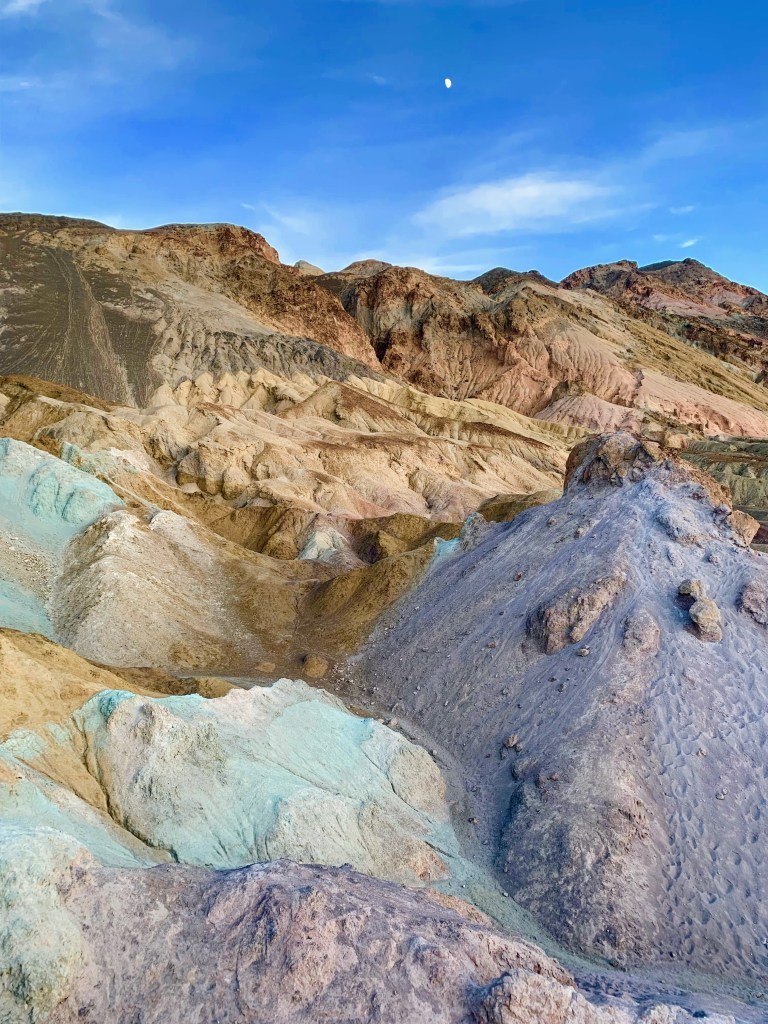
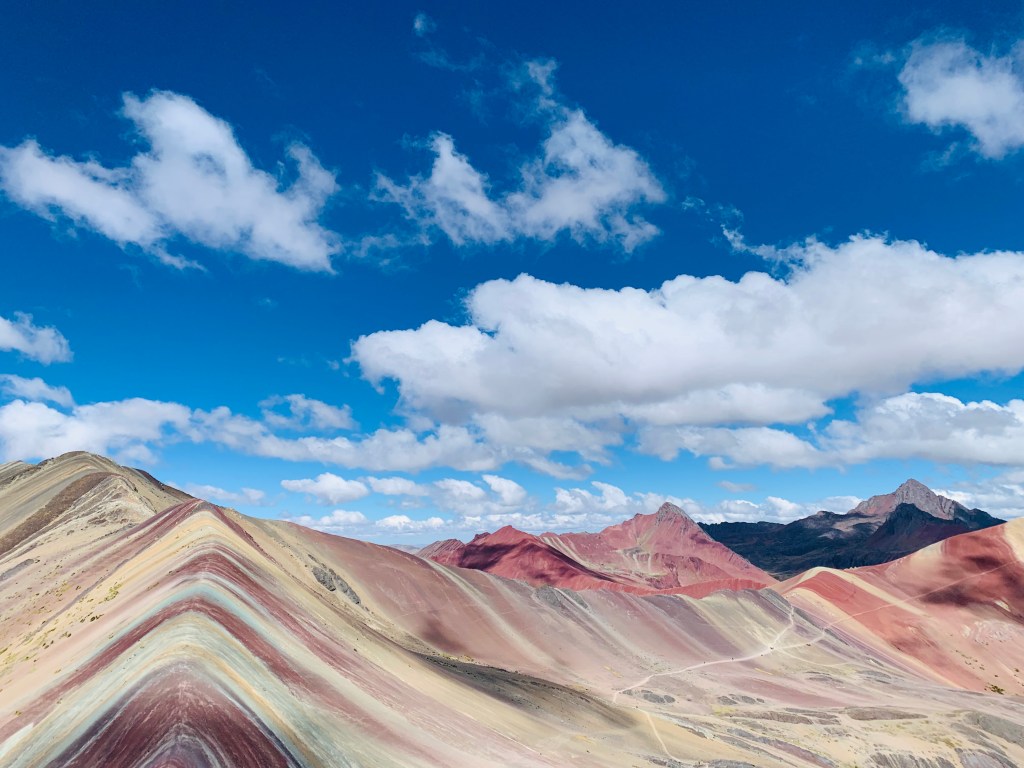
Stained glass rocks in Califorania’s Death Valley and Peru’s Rainbow Mountain
 Third Woods