
If nature's red in tooth and claw
Like winter's freeze and summer's thaw
The wounds she gave me
Were the wounds that would heal me
-Gordon Sumner
My twenties in Poland honed my winter driving skills. My thirties in Southern California atrophied them. Trust in rusted experience is a recipe for disaster. It happens in a split second, as it usually does. I underestimate my speed on the black ice that comes with dusk. A deceptive bend in the road forces the disobedient truck to surrender to inertia. It veers off the asphalt, swings sideways across a snow-covered bluff, trims what could have been a perfect Christmas tree, and snaps a few snowplow poles. Yet somehow it neither flips nor buries itself in the snow. The same inertia that put me in that situation is now my ally and, after a moment of purely instinctive, chaotic maneuvers, I am spat back onto the road. I let out a short scream of excitement and drum my palms on the steering wheel.
“There’s something fundamentally different about aimlessly driving a truck here, in the cold, dark expanse of Montana—seeing miles upon miles—and driving through the jungle, lost in the dense thicket, wrapped in palpable heat and humidity,” I think, leaving Hyalite Canyon and entering the plains in front of the Bridger Range. Yet there’s something fundamentally similar too: specific kinds of freedom that lurk in the unknown.
From time to time, I stumble upon recurring parallels between seemingly disjointed circumstances that activate familiar emotional and intellectual scripts. I’ve noticed so many examples of this different-yet-similar dynamic across latitudes and longitudes that it may deserve its own discipline, pretentiously called peripatetic comparativism.
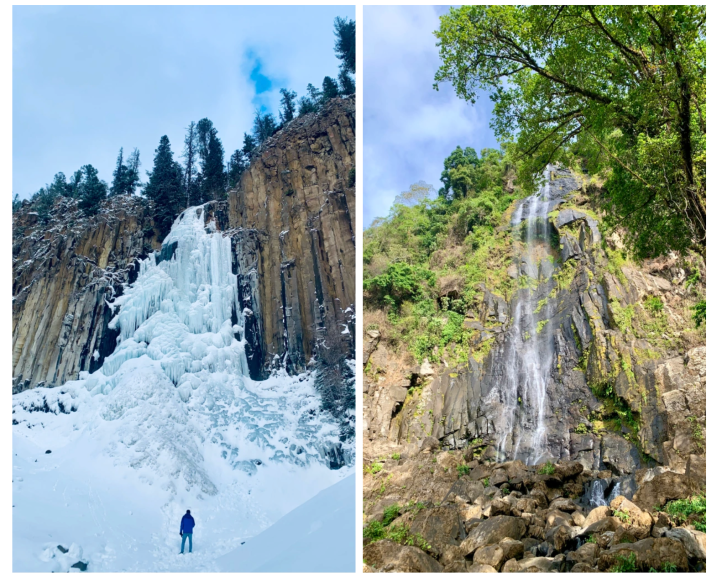
There’s something about Hyalite Canyon that keeps summoning parallels. Last time I was there, I made a similar comparison between Hyalite’s and Costa Rica’s waterfalls.
In the mood for comparisons, I recall a wanderer I photographed today while snowshoeing through a Montanan forest. Is it the same wanderer I photographed a few months ago on the streets of Prague? Is he the embodiment of those specific kinds of freedom that lurk in the unknown?
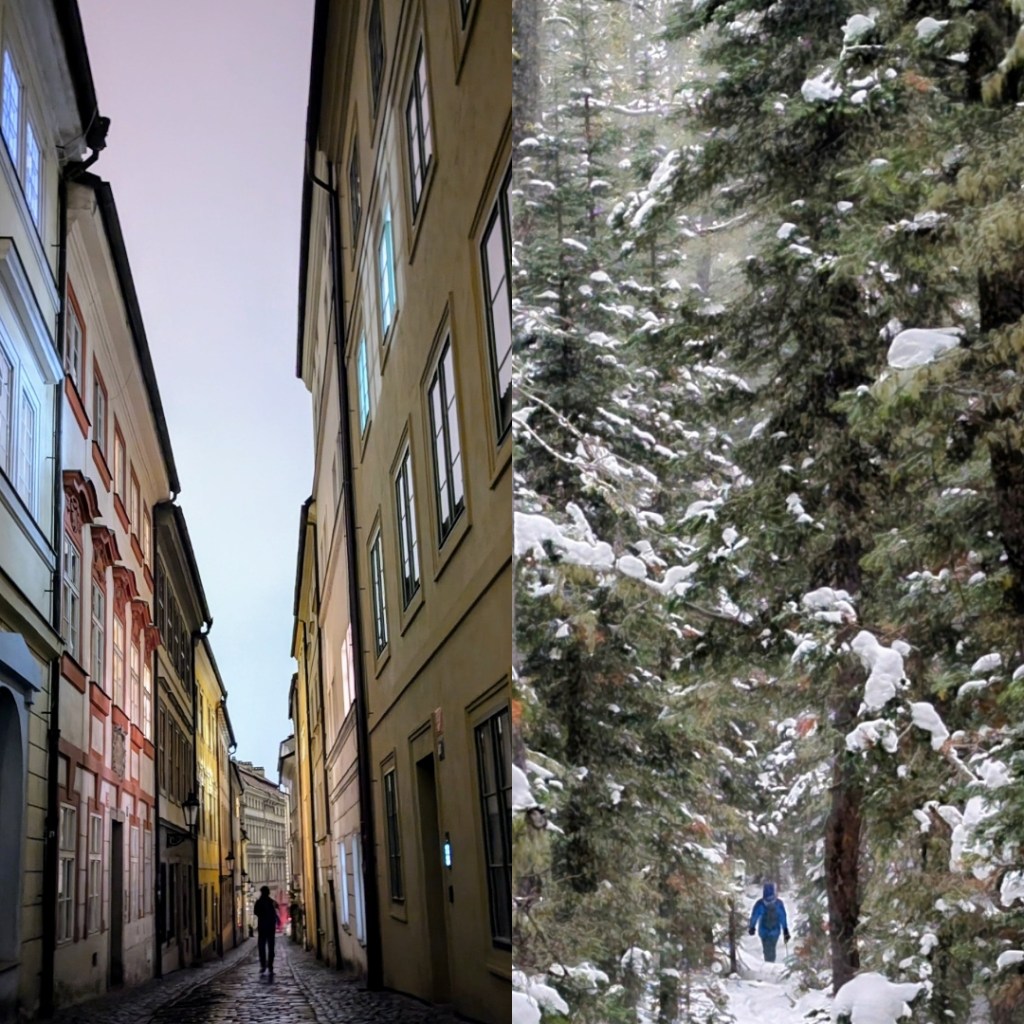
There is a fundamental difference between the unknown in the woods and the unknown in the city (or more generally, in “civilization”). Getting lost in the wilderness, out of reach of cell towers, means the unknown has teeth: cliffs, storms, icy roads, self-reliance. In the city, the unknown is muzzled, it’s declawed. It’s the low stakes of booked tickets and reserved tables. It’s the directions from the comforting voice of the navigation app and the opening hours, clearly specified and updated twenty-four hours ago.
“No spoilers,” I hear a frantic cry from so many people who crave surprise yet fear they might run out of ingredients for their identical everyday breakfast, or who never take a different route. I find a contradiction there: a need for opaqueness and a complete elimination of it. In my fashion, I try to name this contradiction.
opak (n.): a state in which uncertainty has been carefully domesticated—where we seek the feeling of not knowing while quietly ensuring that outcomes stay safe, reversible, and comfortably mapped out. An upside-down opacity of modernity, in which we ban “spoilers” yet rely on ratings, reviews, and navigation to pre-clear nearly every risk and uncertainty.
(from Polish na opak meaning “awry, upside-down”, and English opaque)
With that, I’ll end this peripatetic comparison, because it’s difficult to dictate notes while being interrupted by the comforting directions of the car navigation.
 Third Woods