
We went back down to the valley under our own steam; and to the innkeeper who asked us, with a snicker, how things had gone, and meanwhile was staring at our wild, exalted faces, we answered flippantly that we had had an excellent outing, then paid the bill and departed with dignity. This was it—the bear meat; and now that many years have passed, I regret that I ate so little of it, for nothing has had, even distantly, the taste of that meat, which is the taste of being strong and free, free also to make mistakes and be the master of one’s destiny. That is why I am grateful to Sandro for having led me consciously into trouble, on that trip and other undertakings which were only apparently foolish, and I am certain that they helped me later on.
Primo Levi, Bear Meat
I recall Levi’s adventure while jogging down snow-covered switchbacks just south of Owens Peak. The feet–eye–brain axis was timid yesterday, with the first snow of the season; but now it’s working like a well-oiled machine. The image amuses me for a second: tendons gliding, eyeballs rolling in their sockets, neural cogs turning like the Antikythera mechanism. Everything is dripping grease. This mechanical analogy reminds me of Ted Chiang’s Exhalation.
Inhale! The air is crisp, unlike the slushy snow beneath my feet. Life, here and now, is also crisp, unlike the slush of the city that awaits me. I hesitate to exhale—I want to hold onto the crispness of the air, and of life itself. Everything feels different after tasting a bit of bear meat last night.
There were certainly better days to come here. A large snowstorm engulfing most of the Sierra had been forecast for days, but my companion has kids and a serious job, and he had planned this outing for months. I don’t know these obligations.
I stop and watch him running down the switchbacks. He dropped a pole and is jogging back to recover it. He was close to hypothermia last night. Luckily, I had clothes to spare. It’s warm now, and the melting snow releases a kind of moisture unusual for what is still technically a desert. I inhale the barren landscape.
A skeleton of a tree catches my attention, stark against the bone-colored hills. I let my focal planes shift; I blur the visual field to blur the categories. It’s not a tree anymore—it’s an eroded, dried flash-flood riverbed. I cannot unsee it. I’ve seen hundreds of forms like this when flying east over the desert.
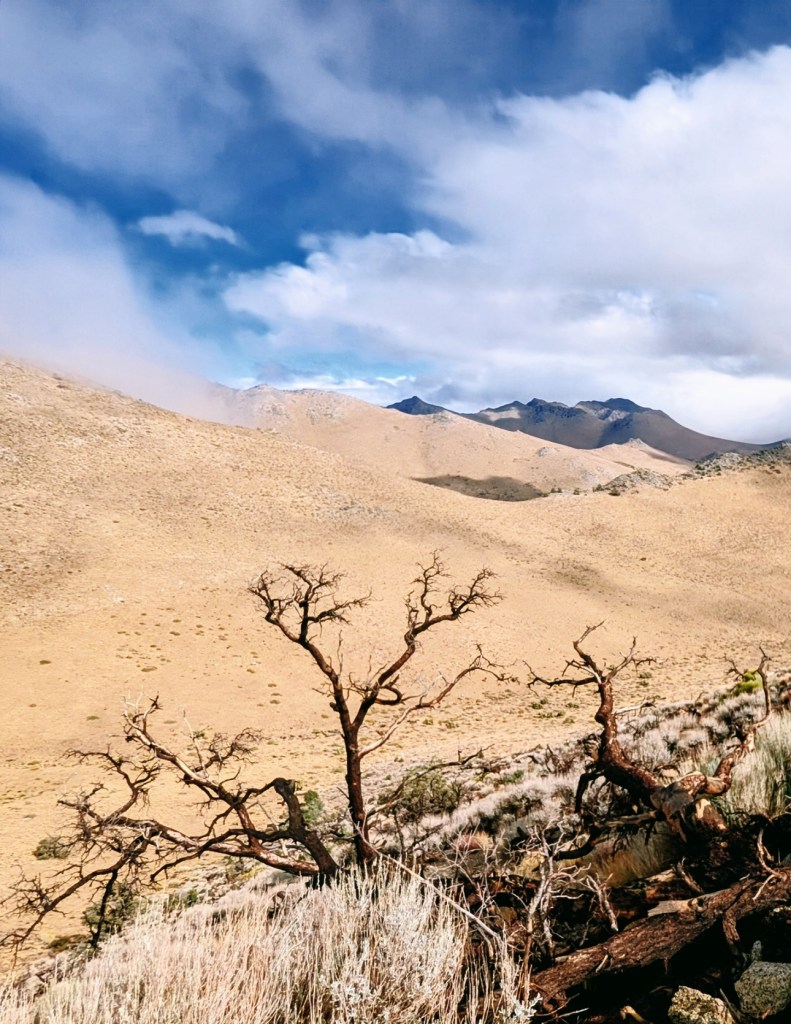
But it is a tree. I know that not only because I can see the trunk and the bark’s texture, but also because of subtler cues I cannot explicitly name. If I had grown up in a cave—as I often imagine in my thought experiments—could I genuinely mistake the two: the tree and the riverbed?
Both structures represent a classical branching problem. Entire scientific lives are devoted to understanding what physical rules produce these remarkably similar, self-repeating patterns across such different systems. Everything about their formation should make them diverge, yet here I am, confused. One structure is embedded in a two-dimensional surface; the other explores three-dimensional space. One develops down the gravitational potential, the other against it. One “grows” from the top, the other from the bottom. One is passive, the other active. One is formed by merging, the other by splitting. Rivers “care” only about minimizing energy dissipation, while trees, in a much more literal, adaptive sense, care about mechanical stability and resource distribution.
I wonder if I could distinguish them in a photograph stripped of dimensional cues, without any sense of up or down? I try to peel away context and knowledge, reducing the visual field to the geometry of meaningless pixels. I list differences: thickness gradients tied to accumulation rate; node geometry, V-shapes versus Y-shapes; the uniqueness of branch junctions. Yet under closer scrutiny, even these distinctions feel derivative—still anchored in what I already know about rivers, trees, and the asymmetry of gravity.
It becomes hypnotic. My thoughts, as if they were water or sap, fill the fractal labyrinth of darker lines. I see it, or more accurately, I feel it. There are small kinks and loops in some parts of the tiny branches that seem impossible to have been formed by flowing water. The water would have to move in two directions at once, and gravity tends to resolve such ambiguities instantly. But again, this is based on my internal concept of “flow,” and on the assumption that the structure was shaped by flow in the first place.
Perhaps it’s impossible to look at any of this in a conceptless way. Maybe in the end the only honest approach is to reduce the problem to mathematics: to the distribution of angles, branching probabilities, scaling exponents, the whole repertoire of nodes and ratios. A thing impossible to perform on the spot for my non-savant mind.
I see a tiny figure emerging from behind a big rock. My companion waves at me with the lost pole in his hand. I smile, relieved that he is still energetic after the freezing night and the hard climb we did early in the morning. Once again I recall the “bear meat” from Primo Levi:
That is why I am grateful to Sandro for having led me consciously into trouble, on that trip and other undertakings which were only apparently foolish, and I am certain that they helped me later on.
But this time I have become Sandro—and it might have happened too late. I’ve been surfing an illusion of freedom for so long that I forgot my friend has a wife and two small kids, and that “teaching” him to climb in such conditions was simply irresponsible. Not bear meat at all, but donkey meat. Bear meat is for those who are free—free through youth, or through the illusions that substitute for it.
I look again at the tree. Or is it a riverbed? Up the gradient and down the gradient. And I realize that my companion and me—or me and my companion (because who can tell which is which)—are like those similar yet different structures. Our lives have diverged, each drawn toward its own attractor, yielding outcomes that resemble each other just enough to confuse the eye. (Aren’t we now just a couple of tired trail runners?)
In the case of branching structures, we could talk about—loosely borrowing from dynamical systems theory—morphospace attractor basins. What kind of space do our life-modes form? That’s a question for another time (or perhaps there’s no question at all), because my friend has caught up with me. I recall that he’s a vegan, so perhaps it wasn’t donkey meat after all—just Impossible™ meat. I smile at the thought and refocus, because I still need to drive him safely back to his family.
 Third Woods