
The Anxiety Sense
There is a strange shimmer filling the Ishinca valley. “Shimmer” isn’t the best word, because the thing is palpable. Only my climbing partner and I can perceive it. We feel it on our skin while walking between tents, checking gear, killing time. I wonder whether it’s not a separate, uniquely human sense. Birds navigate magnetic fields, snakes see thermal radiation, spiders react to vibrations in their webs, the lateral line in fish lets them feel the water. The world is full of sensory modalities beyond our comprehension. But maybe only we can literally sense the future. Maybe this is what we call anxiety.
Illuminations
Our porter Federico seems untouched. He wears a T-shirt that says “Cheese,” and he always smiles. I already know that one day this accidental detail will become an illumination in one of my stories—one of those small, decorative touches, like the ornate initials in medieval manuscripts. I find this metaphor bizarrely non-metaphoric: there is the main storyline, clearly calligraphed in memory, and then there are the small details worth remembering as illuminations, inked light shed onto the storyline. Inked light? Inked cheese? There is a strange shimmer filling the Ishinca valley.
General Relativity
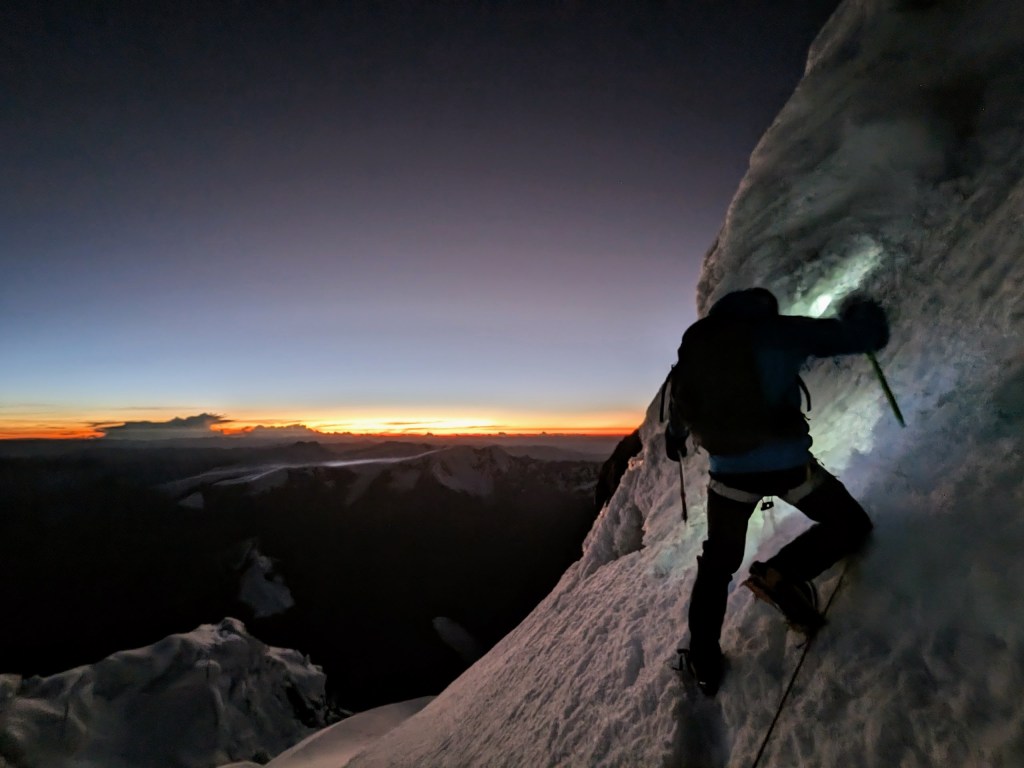
Our guide Fredi seems untouched as well. Tonight he is taking us over crevasses and up ice walls to the top of Tocllaraju, the mountain closing the mouth of the valley. Now he is reading something on his phone. I see his mouth moving slowly, parsing every syllable. It reminds me of Dawid from my elementary school. Kids made fun of him because he struggled with reading out loud. For a second I see Dawid in Fredi, and then I flip the view.
It happened that we grew up in a society where reading is considered a valuable skill. So valuable it has its own big word. Literacy! It has been stretched to encompass “understanding” and “proficiency.” But if we grew up in a society where agility and climbing were more useful than reading, all the nasty, literate kids (including me) would be mocked and bullied, and Fredi-Dawid could be the bully. It’s all relative.
Yesterday Fredi took us to the crag half a mile from camp to literally teach us the ropes. I wonder if the way I read in school ever seemed as impressive to Dawid as Fredi’s knot-tying and anchor-setting seem to me now. I felt clumsy, incompetent, slightly embarrassed. My fingers were moving slowly, parsing every turn in the rope—just like Fredi is parsing syllables now. It’s all relative.
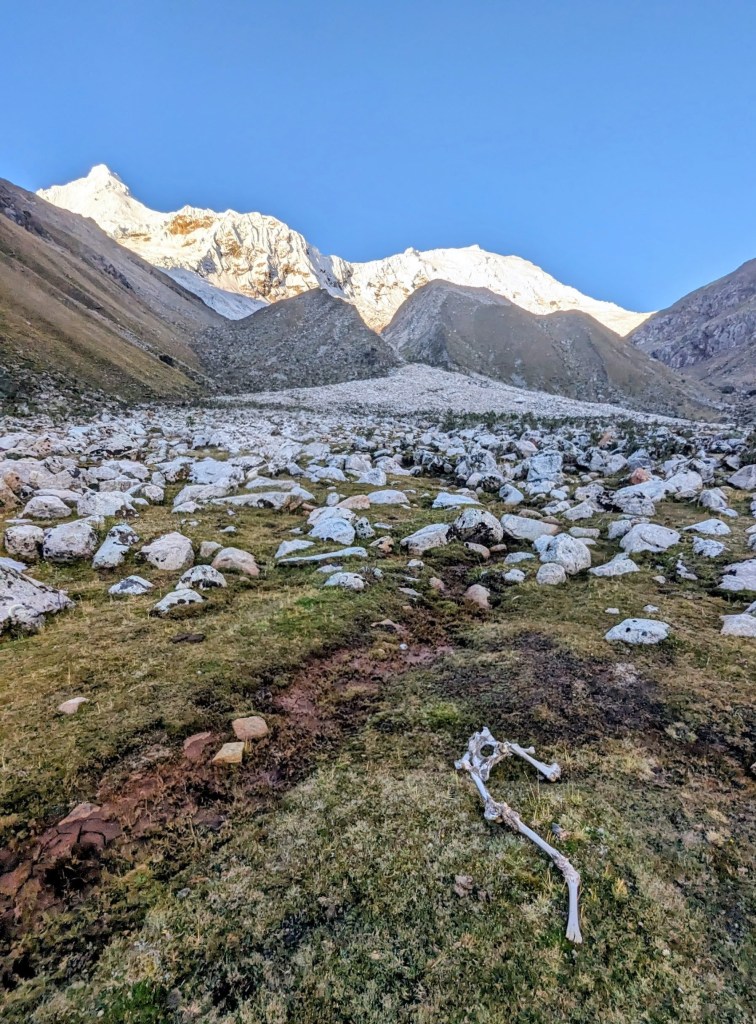
I walk through the shimmer to the Ishinca river. Something skeletal lies among the rocks—same color, almost invisible until its elongated shape gives it away. Legs and pelvis. For an instant, they look human. The shimmer intensifies. The meltwater from the glacier above is unsurprisingly ice cold. Unsurpr-ice-ingly. What else did I expect? A few days ago, as we were hiking to the base camp, the river lured us with the promise of respite from equatorial heat. “An American died of pneumonia after jumping into the river last year,” Fredi warned, seeing the same idea in our eyes. Now, after a few cold nights at altitude, swimming seems unimaginable. Then and now. Here and there. Parsing syllables and knots. It’s all relative.
 Third Woods