
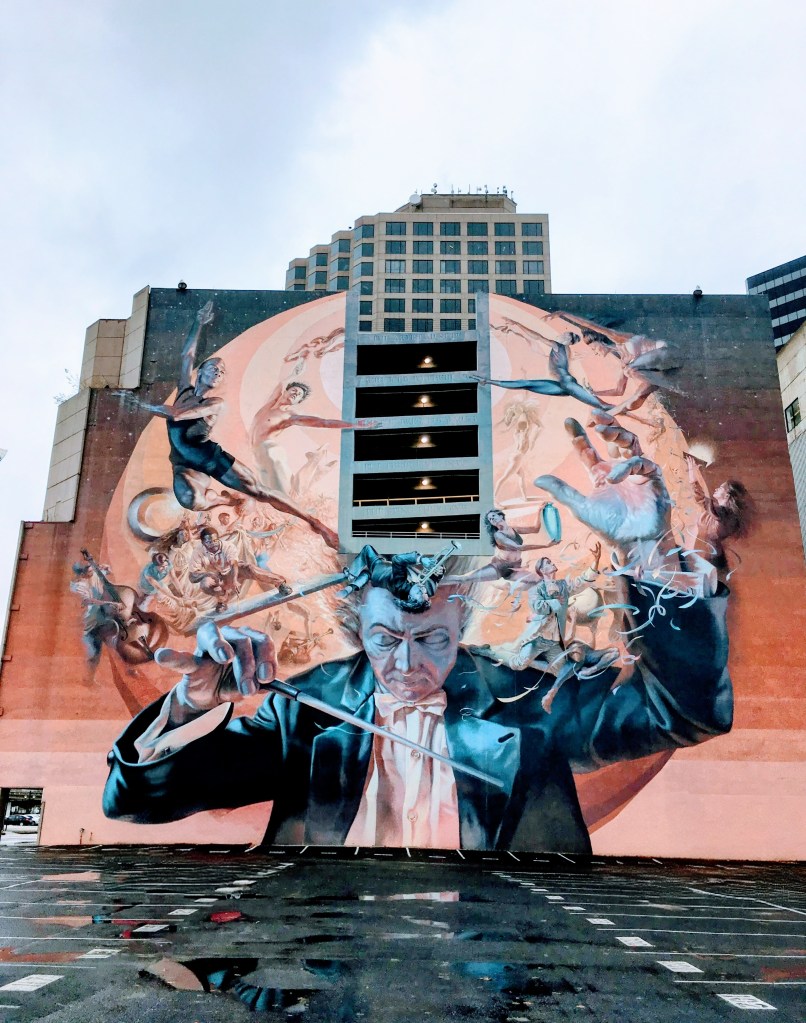
“We flow like rivers,” I think, carried by the advection of the crowd. Midwinter has wrapped us in somber black coats. I squint and see heads drifting on the surface of a dark current of bodies. The river runs uphill, against gravity, climbing long staircases, spilling onto a gray platform to startle equally gray pigeons.
“We flow like rivers,” I think again, noticing the concrete steps worn smooth by a million human steps. Our steps, singularly insignificant, by sheer shear repetition, erode stone. I imagine the mataf at al-Kaaba, the whirl of people circumambulating, carving a circular valley. I spill onto the platform. The gray-white glare of snow heaps burns my eyes. A train pulls in with the screech of brakes frozen stiff by cold. The screech burns inside my ears, cold.
There is an untranslatable irony in the fact that the early stages of my adulthood were spent on a train to Poznań. In Polish, shrink Poznań to poznań and it becomes a train to knowing. Indeed, train travel ought to be written into the curriculum of life. Stories from the pages of books, stories of briefly acquainted strangers, stories of the landscape changing outside the window. These three focal lengths, and the shifting between them, form one of the straightest winding paths toward knowing. Whatever that might mean.
We enter the causeway slicing through a narrow retention lake. Its black, not-yet-frozen surface cuts the land freshly whitened by low-hung, heavy clouds. A classic winter paysage, an aquarelle per se, where almost everything within reach of the eye is water. Snow, clouds, lake. Even the fellow passengers: bladders stitched by ontogenesis into human form. In the musical background: Frederick Delius’s Aquarelle (Lento, ma non troppo). A bird cutting a cloud with its wing is like a fish cutting the deep with its fin. Time is a bird and a fish. Time flies and time flows. And it cuts me with every second.
The gray-white austerity is suddenly cut by the colorful chaos of graffiti in the industrial suburbs. The train slows, and I gradually start fishing signal out of noise. Shapes. Geometries. The artists’ intent. I can see how older layers have morphed into the newest ones. A street palimpsest.
I recently ran into the term graffiti music. It’s the kind of category that resists definition and reveals itself best through examples. Graffiti music might be my favorite genre. Music in which consonance and harmony are not obvious. In which structure emerges at a broader temporal resolution than a measure. In which the whole forms a sonic stain—until you listen closer and are surprised by the non-accidental, unmistakable intent. This is not an easy feat, nor is it easy art. It is something crystalline and avalanching, the kind I have already written about.
My memory rails, and my musical preferences, have made me realize that the way my mind writes reality could also be filed under graffiti. Contemporary neurophilosophy gives us at least two clean handles for this. One is the old Bergson–Huxley idea of the mind as a reducing valve: a largely eliminative organ, protecting us from drowning in irrelevant perception, letting in only what keeps an animal alive. The other is the modern predictive-processing framework: the brain as a forecasting engine, a model-builder, registering the world not as it is, but as its best guess, updated only when reality refuses to fit. In both stories, the brain is a kind of editor. It cuts. It omits. It decides what gets to count as “seen.”
And yet I’ve noticed that more and more often I slip into a kind of controlled madness in which I loosen the editor’s grip. I let the mind absorb as much as it can, let it throw out hundreds of associations, and only then begin to fish out motifs, consonances, harmonies, layers in the palimpsest. If there is graffiti music, there is also graffiti thinking. It, too, resists definition and reveals itself best through examples. Perhaps Third Woods has become a catalogue of such examples. But I also have a weakness for naming and defining things that do not yet have names. So here is a new one.
graffinking (n.) a deliberate mode of perception and thought in which the mind temporarily suspends its usual filtering, allowing an excess of impressions, associations, and meanings to accumulate—only later reading this layered field for patterns, motifs, and emergent structure. A way of thinking that favors palimpsests over clean slates, stains over lines, and delayed insight over immediate grazing.
 Third Woods