
cutombolo (n.): a corrective impulse, half-moral and half-aesthetic, to return things to their natural order. You are aware the premise is flawed, because everything that happens is, in some sense, natural. Yet you still want a cut, a clean severing of the connection that binds the remote to the mainstream, the particular to the global. A wish for places to regain their separateness, not by building walls, but by letting the world have its distances back.

(from English cut and Italian tombolo, a sandbar or strip linking an island to the mainland)
The thin strip of sand
the mirror on the whale’s tail
where everything begends
Uvita
The ocean frays the land, wave by wave, in countless repetitions. It is a frayed image, invoked by art and imagination countless times. My own frayed attention craves a change, so I turn around and face another ocean. It frays the land, wave by wave, in countless repetitions. It is a truly uncanny experience. An ocean in front, an ocean in the back. Stuck in a marine embrace. Perhaps this is where the world looks at itself in a mirror.
I stroll further to the end of Cola de la ballena, the Whale’s Tail, a prominent shoreline feature in Uvita, Costa Rica. I gaze towards the land, along the Tail. If not a mirror, this narrow strip of sand could be the crest of the world, the very line where the sphere begins and ends.
Or ends and begins.
Neither in geography nor geometry (funny how close these words are) does such a line exist.
Yet here I am.
Or there I was.
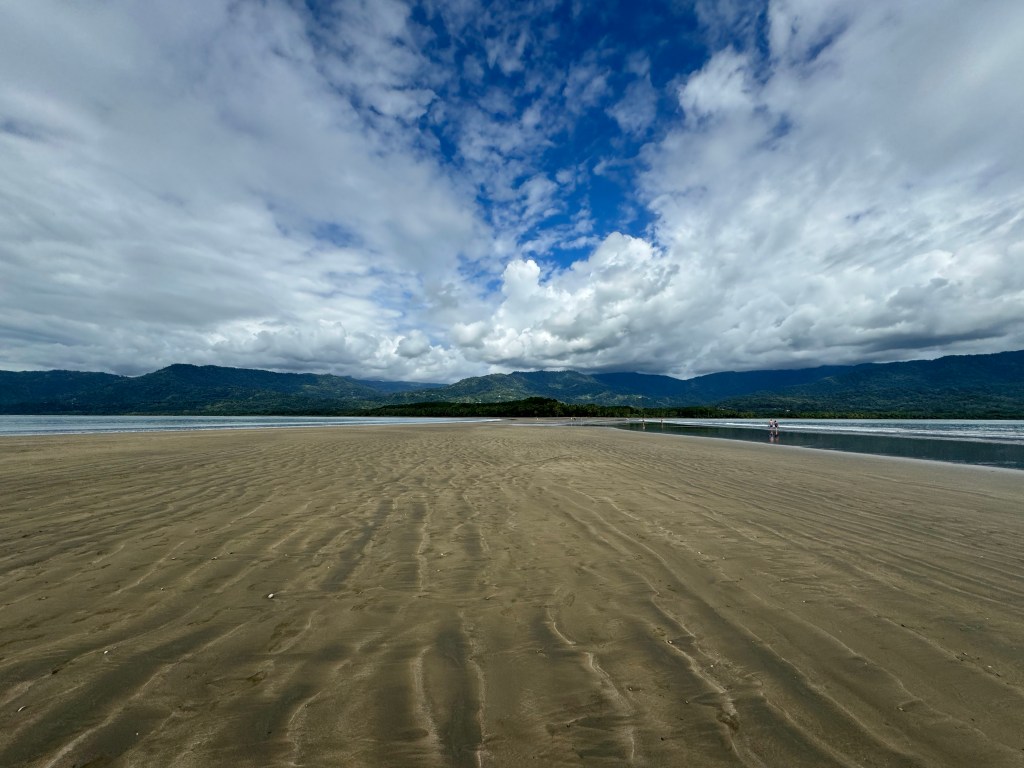
The symmetry of the Whale’s Tail
Maui
Shorelines are not only a frontier set by our land-dwelling physiognomy. They are also a place of contrasts. You appreciate this in places like the Whale’s Tail, where the contrast is missing and our perceptual systems go awry.
I am biking now in northwest Maui, Hawaii, and the contrast is dramatic. Barren volcanic slopes press against the azure of the Pacific. I just changed direction and I am cruising downwind. I relax into the pace and notice an inconspicuous similarity between land and sea, as if they were reflections in some kind of Turing-patterned mirror. The uniform surface of the ocean is dotted with white manes of waves. The uniform surface of the slopes is dotted with rocks, scattered evenly by an ancient eruption.
Both the road and the wind turn slightly, but in opposing directions, and I am suddenly hit by an insane headwind. It feels as if it had the whole world to gain momentum. It culminates here and tries to blow the bike from underneath me. I need to pedal downhill to keep moving. Is that what the cliffs feel when the entire ocean leans into them?
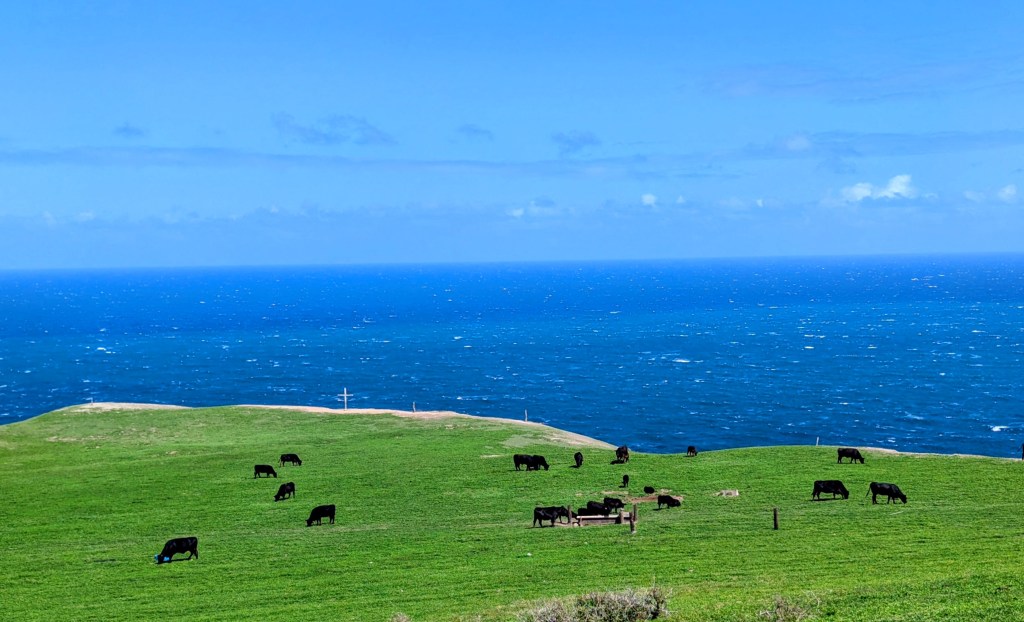
A herd of black cows grazes near the cliff’s edge. Another dotted pattern. “This one doesn’t belong here,” I think as I descend towards a small village sheltered in a cozy cove. In the village I pass an old cemetery, an open space dotted with gravestones. I stop and check the names, expecting Hawaiian ones, the ones that belong here. The stones are covered in kanji, so the graves are most likely Japanese. “Do they belong here?” I ask myself. I ask myself the same question constantly in Hawaii, and I do not have the answer.
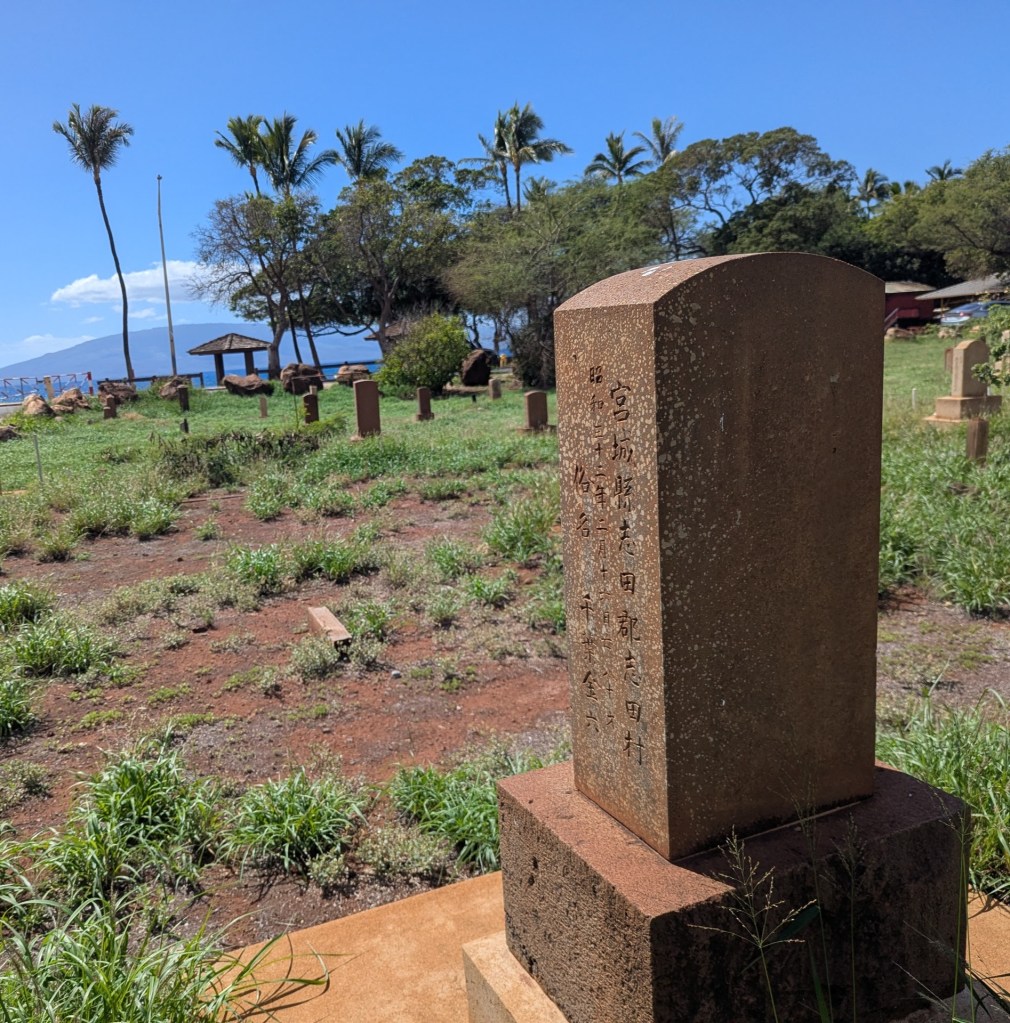
The island fauna evolved without mammals for millions of years. Did the ancestors of the only endemic bat make the insects think, “They don’t belong here!”? Did the birds say the same about the first Polynesians, who brought not only their hunting skills but also other mammals that began decimating the fauna? Did the Asian indenture servants, the Japanese sugarcane plantation workers, belong here more than the whites who exploited the natives and the land? My questions are validated by a sign I pass: 87% of houses north of here are short-term rentals.
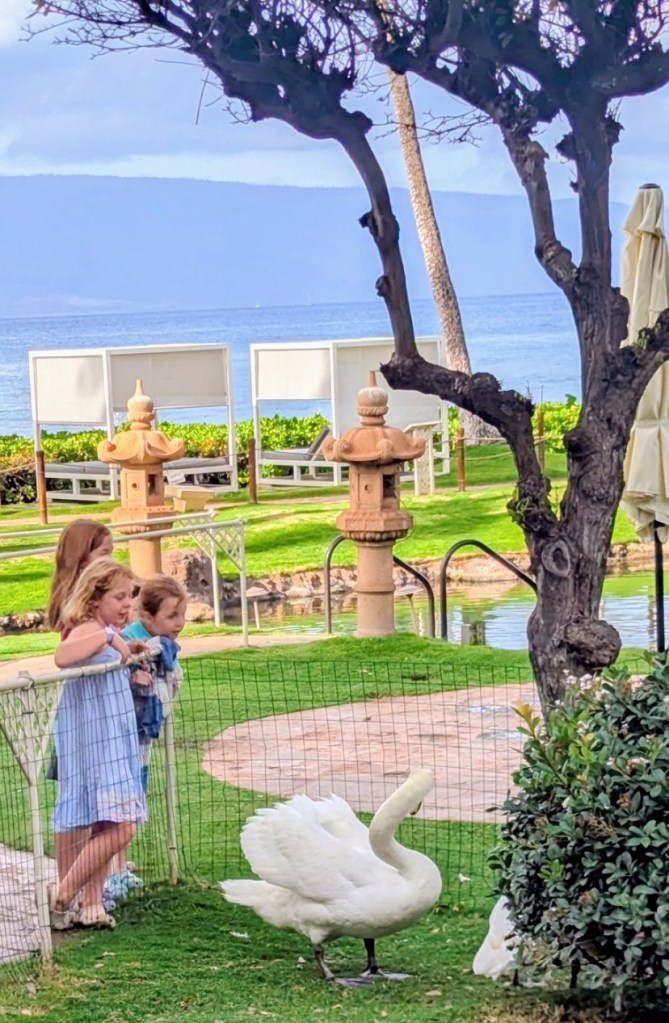
I stop at a Hyatt to refill water. There is a bunch of white swans and a bunch of even whiter girls watching them. They do not belong here. There are South African penguins in the hotel lobby. There are big cages announcing “Hyatt Parrot Hours 8am to 1pm”. There are traditional hula dancers next to the cages. Stripped of honest roots, the capitalist show seems no different to me than the caged parrots. Everything here seems wrong.
I pass crowds of tourists. Mostly white, mostly overweight or extremely fit. Both are signs of privilege. I stop by a small, empty beach and sit next to traditional canoes. I look at the setting sun, and for a moment I pray for a tsunami to come and wipe it all out. Maybe the few boats next to me could save the last few bits of honest tradition.
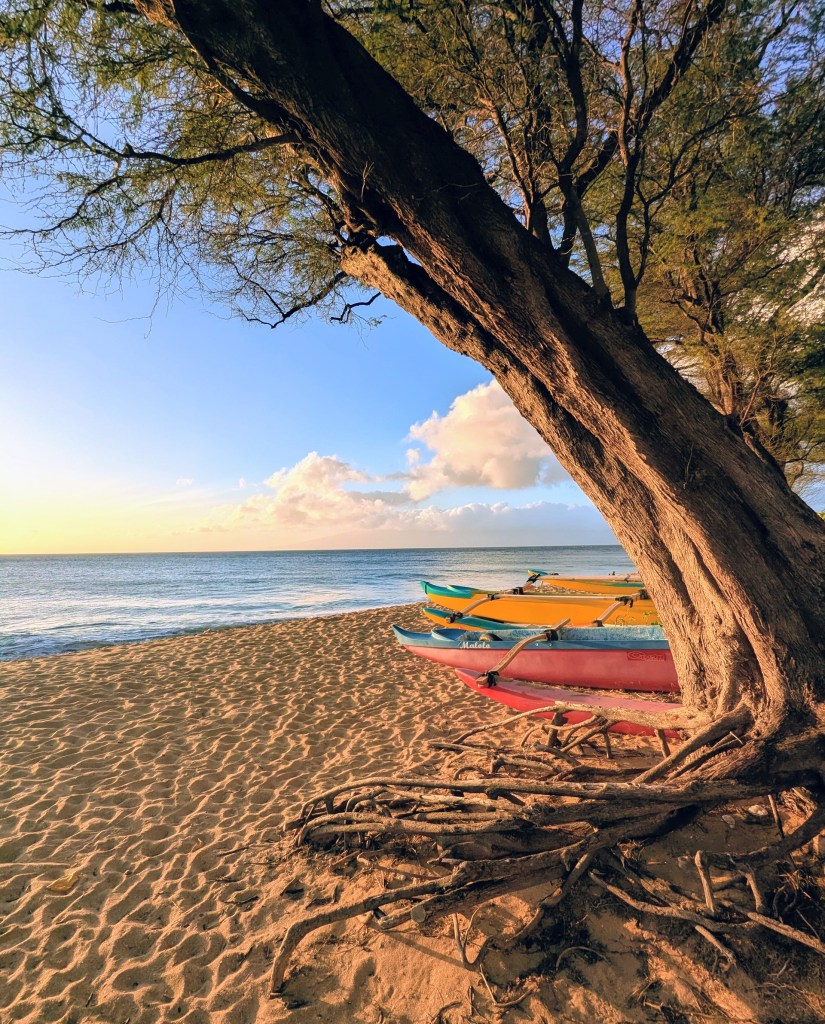
A few years ago, when I visited Oahu and Hawaii Island, my mind also acknowledged the oncogenic nature of globalization and Western culture, but there was an unspoken consent fed by a feeling of hope. Today I have no hope, and the fact that I once had it makes its absence even more hopeless. There is no emotion attached to it, no sadness, no pessimism. But there is no hope. Maybe one for a tsunami. Or maybe for a place like the Whale’s Tail, where the beginning meets the end and the end meets the beginning. For a place where hope grows and eats its tail.
 Third Woods