
What is Third Woods
My grandfather left me more than genes, memories, and words I use below. He left me shelves of books, filled with notes, newspaper clippings, and photos for the “rhetorical later”. This collection, along with scraps of handwritten thoughts, symbolizes our loneliness in the world. We compose every person, no matter how close they are, from the “clippings” presented to us in daily interactions. In a mirror image, we too remain the same collage for others. As Lloyd Trefethen wrote in a similar observation: Yes, I have good conversations with my wife and my children and my friends. But in the end they don’t follow the full pattern of my thinking, just some pieces. On the inside, an active mind feels like a coherent pattern. An outsider sees it only partly, and when the life is gone, the pattern is lost forever.
The Third Woods is an abstract construct intimately intertwined with my evolving character and worldview – a pattern coherent only on the inside. Just as forgotten notes cannot fully capture my grandfather, a few paragraphs cannot fully explain the essence of the Third Woods. However, just as walking the paths in a forest brings us closer to its full topography, any text published on this website should make the idea of the Third Woods less vague.
The term Third Woods refers to the lecture Two Cultures by C.P. Snow, which examines the divide between science and humanities, and to the collection of essays Walden, or Life in the Woods by H.D. Thoreau. With regard to Two Cultures, my aim is not to straddle the intercultural gap, but to work out an alternative. Walden, on the other hand, is a subtle nod to transcendentalism. In fact, the main inspiration for the Third Woods was Walt Whitman’s Song of Myself, which balances between transcendentalism and realism. The woods, however, as a space, better reflects my vision than a song.
As a convert from the musical arts and humanities to science, I considered myself a representative of both cultures from Snow’s lecture. The Third Woods is a paradoxical attempt to both abandon and maintain the Manichean thinking that divides the two. It is meant to take into account one’s own experiences, both those from which scientific and humanistic “truths” can be deduced, and those in which any thought and analysis disappears. As Whitman wrote in Song of Myself:
You shall no longer take things at second or third hand, nor look
Walt Whitman, Song of Myself
through the eyes of the dead, nor feed on the spectres in books,
You shall not look through my eyes either, nor take things from me,
You shall listen to all sides and filter them from your self.
Each way of perceiving reality (scientific-artistic; reductionist-holistic; objective-subjective, etc.) excludes the other at a given moment, favoring the particular mode of experience. However, despite the temporal impossibility, you can learn to change the focal plane smoothly and involuntarily, so that at the seemingly same time you can see a detail and the bigger picture.
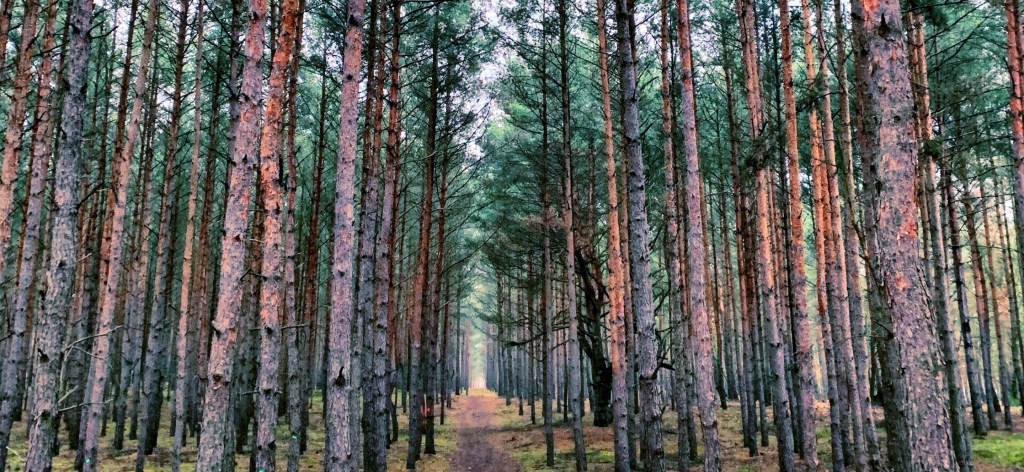
Indeed! The Third Woods is a pursuit of a bigger picture, a wider perspective. It is an effort to notice… the woods among the thicket of trees.
 Third Woods