
Illiniza is a masculine mountain, at least according to the now extinct Kunza language. As we were leaving the mountain pass between the southern and northern summits of Illiniza, one of the apus, the Andean spirits, decided to test our masculinity with a gale.
There is a surreal intimacy in the open space closed by a cloud and pressing wind. There is also a fleeting unchanging element in it. The eye of my memory, as well as the eye of the camera (vide video), similarly see the gale on the pass in Ecuador and the windstorm on the cliffs of the Inner Hebrides.
Winds on Illiniza Norte (Ecuador) and on the cliffs of Isle of Skye (Inner Hebrides, Scotland)
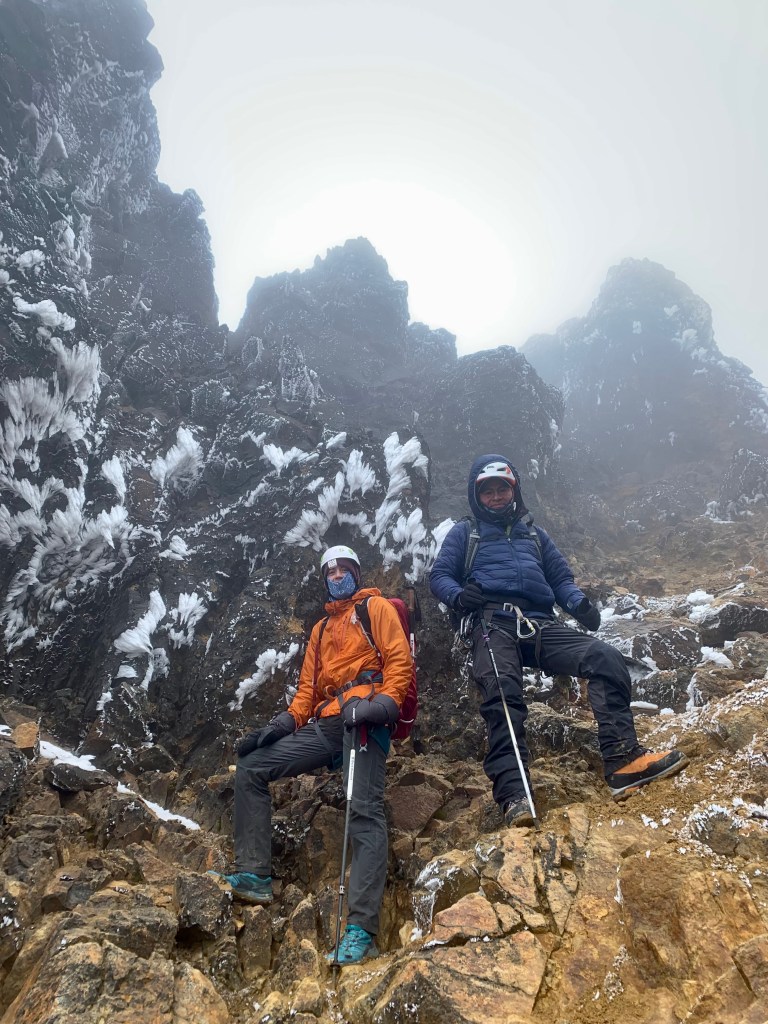
I was hoping that the path would circumvent the ridge, lurking in the fog ahead, on the leeward side. Instead, it followed the ridge’s blade, and then descended a bit on the windward side. We were tested further. Pressed by the wind against the basalt wall, we walked a little more confidently over the chasm buried in the clouds. Perhaps it was a guardian spirit?
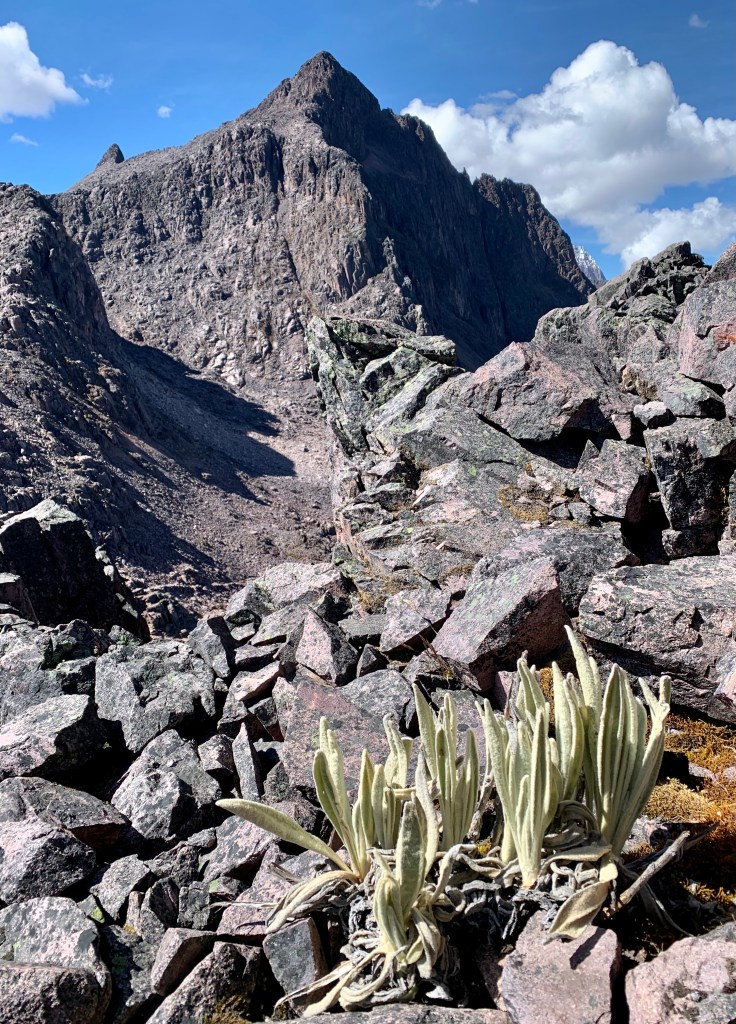
The wind was fishing out water droplets from the sea of clouds, petrifying them momentarily in rock crevices, and in our week-long bristles. After a few minutes, our faces were covered with a layer of ice. Before our eyes otherworldly icy structures began to bloom from the rocks. I had seen horizontal icicles of hard rime on lonely trees of mountain peaks, but not vertical ones, shooting to the sky. Upon hitting the solid volcanic slopes of Illiniza, the wind bent, causing ice crystals to sprout upwards like leaves of rimy shrubs. I am always struck by the often not accidental1 convergence of forms in nature. Those frozen structures were reminiscent of plants that I had seen before in the Peruvian Andes.
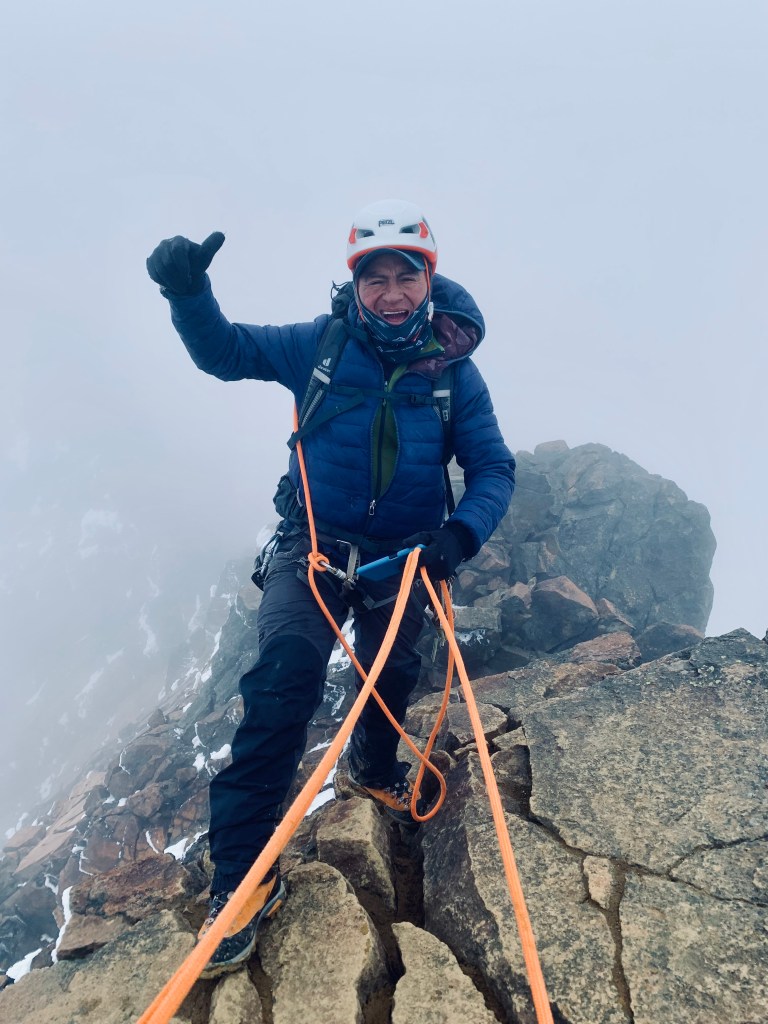
By reaching the summit, we passed the test of Illiniza’s apu. The wind softened, allowing for congratulatory hugs and trophy photos. We started the descent on a different, easier route. Protected from the elements, we had the first chance to talk casually with our guide Fabian. He belonged to the Quechua people, and grew up speaking Kichwa language. He had learned Spanish, which we spoke, in school. We picked up a few basic Kichwa words, briefly discussed our plans for the next few days, and everyone moved at their own pace. Fabian walked in front, knowing the route by heart, he was nonchalantly checking his phone. My companion Luc, raised in the mountains of Montana, followed him closely. I, the heaviest one, stayed behind, carefully navigating the slope covered with loose volcanic dust.
I was leaving the cloud and a stunning plain emerged in front of me, with the perfect cone of the Cotopaxi volcano looming in the distance. Yet I did not really see it. Thousands of cautious steps, each with maximum focus, can put you into a trance. I learned a large part of my Spanish from the Duolingo app, and its interface hovered in my visual field. Virtual signs with Spanish phrases appeared and disappeared in that unusual hallucination. My brain, dazed from fatigue and lower oxygen levels, was recovering from a recent conversation with Fabian. Suddenly, one of the virtual tiles turned red, indicating a mistake. I realized that in the previous conversation I said “varias idiomas extranjeras” – several foreign languages. The problem is that the word el idioma is a trap word, in which my tired, fast-spoken Spanish got caught. I added feminine adjectives to a masculine noun ending with a “feminine” “a” (as a native Polish speaker, with Polish being a gendered language, I can feel what the mistake could have sounded like).
As I walked down the naturally formed stone steps, I thought that my delayed autocorrect was a bona fide l’esprit d’escalier. I was initially amused by this Latin-French observation, but after a while it dawned on me that it only made sense in the English usage of bona fide, which is often used to mean “genuine” – possessing particular characteristics. In that context, it was my reflection on the stairs – l’escalier. On the other hand, in the Polish use of bona fide – “in good faith” – the entire phrase bona fide l’esprit d’escalier would make no sense. For the peace of my purist soul, I swapped Latin to uniformly French par excellence l’esprit d’escalier.
That internal Angloslavic dialogue about Latin bona fide pestered me. I looked back at the “mountain of babel” we had just descended. I saw our group from half an hour ago. There I was, thinking mostly in Polish, speaking Spanish with a Kichwa-thinking guide, and translating the sentences into Luc’s native English. In that chain of three minds, Fabian’s sentence was passed through Kichwa, Spanish, Polish, and English. Luc’s reply went in the opposite direction. Of course, the translation was more or less direct, depending on the translator and the sentence. I am convinced that Fabian, who learned Spanish as a child, did not translate sentences the same way as I did. By the same token, I do not translate everything from Polish to English anymore. Many sentences “happen” within me only in English. I suppose, though, that many of the thoughts from which the sentences arose occurred in our native languages.
I looked away from the summit and looked into the “babel” of myself. There is a certain superpower in knowing a foreign language, the key to other cultures, to other souls. However, there is also a kind of ill, a collection of ills, a syndrome that progresses along with better mastery of a new language, especially by spending a long time in the midst of its sound. The new language begins to master the masterer. Native words fade away, native syntax breaks down. Thoughts in the mother tongue – once quick and agile and graceful – now walk awkwardly as if through loose volcanic dust and thin air. It would not be so bad if the newly acquired languages took over the impetus and agility of the old one. But instead, they intertwine, creating slow and clumsy thoughts.
Is it inevitable? Many writers have written beautifully in exile. Examples include Conrad and Nabokov, who wrote beautifully in a foreign language. It appears that some are immune or cured of that syndrome that I have called Illiniza Norte. The name – a combination of Kunza and Spanish – aptly captures the linguistic confusion of thoughts that troubles me.
What is the prognosis for me? I am nowhere near the linguistic immunity of Conrad or Nabokov. But as befits a scientist, I am searching for a solution and conducting clinical trials. My tested remedy: writing in Polish first and then translating into English.
1I do not mean “non-accidental” as synonymous with “planned” or “designed”. This coincidence is not the result of any supernatural thought. Rather, certain fundamental laws, such as energy minimization, lead to the rhyming (not riming) of processes and structures on various spatial and temporal scales.
 Third Woods