
Beyond the tangible objects we stack on shelves or tuck into drawers, there are the abstract ones, artifacts of thought and imagination with which we fill the mind. Take the alphabet, for instance: an arbitrary sequence of symbols that not only lets us impose order on words, but also acts as a filtering tool—one that imposes a choice. I fill my mind with alphabets.
At times, it feels like everything stored in my memory fights for the slivers of my attention. And since I’m bound by the mind’s architecture to think only one thought at a time, those cast aside turn into an aggressive swarm. In such moments, alphabetization works like a beekeeper’s smoker—it soothes the swarm and lets me extract thoughts that matter most.
For example, to clarify what I search for in daily experience, I recently created the Alphabet of Everyday Pursuits. Some of its letters read:
A: Activity (as opposed to passivity) | B: Beauty | C: Challenge | D: Depth | U: Understanding (of phenomena, mechanisms, myself)
I’ve also created the Alphabet of Creative Resonance—a list of artists whose work harmonizes in a striking way with my sensitivity and perception of the world. Included are:
H: Hopper | K: Kabaret Starszych Panów | L: Lem | P: Pessoa | S: Szymborska
The letter B remains contentious, as Borges and Bon Iver are locked in a quiet duel. Today, leaning into the mood of this piece, I side with Borges.
Borges was a master of creating objects that were material, yet impossible—forms through which the unimaginable becomes briefly graspable. The most well-known is the Library of Babel, which illustrates the paradoxes of infinity. If I were to create an Alphabet of Borges, L would, without question, stand for the Library. And at the beginning and the end—how else could it be?—the Aleph and the Zahir.
Aleph
The Aleph, as Borges describes it, is a point on the nineteenth step of a basement staircase—a small, iridescent sphere in which everything that exists on Earth at a given moment is visible, simultaneously and from every angle. The very idea of gazing into the Aleph defies the limits of human cognition. Still, following Borges’s lead, I’ll try to render the experience as a stream of consciousness:
I saw the sun rise and set at once, reflected in snowfields, on the sea’s surface, on desert sands, and in the cataract-clouded eyes of a homeless wanderer on the streets of Durban. I saw a bead of sweat trickle down the neck of a taxi driver in Montevideo, and at the same time down the necks of thousands of other drivers in thousands of other cities. I saw an aphid swaying gently on a blade of grass somewhere in a Slovenian meadow. I saw the whirlpool formed by a stone dropping into the Drwęca River. I saw the alpha female of a painted dog pack biting through the fourteenth umbilical cord in a litter of seventeen—two of them stillborn. I saw hyenas lift their heads at the scent of bloody placentas. I saw lovers in endless constellations of bodies, dancers in hundreds of choreographies, a bloodied head slumped over a steering wheel, and a woman from Pérez Zeledón with a smile I’ll never forget. I saw a flake of rust on a container used for storing post-liposuction fat, and a ruptured bag inside. I saw a man finishing a perfect poem, and next to him, a hundred thirty-six hopeless poets. I saw grains of sand in the intestines of termites. I saw specks of pigment beneath the skin of a skinny arm. I saw a needle spinning at the edge of a worn-out vinyl record, and another needle piercing a corpse in an autopsy. I saw a tear soaking into a frayed carpet and a milk tooth on the palm of a proud eight-year-old girl; I saw the life line on that hand and the dirt under the nail of her left ring finger. I spotted a small lump on my pancreas. I saw the reflection of the word “word” in the gray-green iris of a tired eye. „I saw the coupling of love and the modification of death; I saw the Aleph from every point and angle, and in the Aleph I saw the earth and in the earth the Aleph and in the Aleph the earth; I saw my own face and my own bowels; I saw your face; and I felt dizzy”. And then the thought of the Library of Babel within reach of the Aleph made my stomach turn.
This futile exercise in imagination can swallow you whole. So can the Zahir.
Zahir
As Borges writes:
„In Buenos Aires the Zahir is an ordinary coin worth twenty centavos. The letters N T and the number 2 are scratched as if with a razor-blade or penknife; 1929 is the date on the obverse. (In Guzerat, towards the end of the eighteenth century, the Zahir was a tiger; in Java, a blind man from the Mosque of Surakarta whom the Faithful pelted with stones; in Persia, an astrolabe which Nadir Shah caused to be sunk to the bottom of the sea; in the Mahdi’s prisons, along about 1892, it was a little compass which Rudolf Carl von Slatin touched, tucked into the fold of a turban; in the Mosque of Cordova, according to Zotenberg, it was a vein in the marble of one of the twelve-hundred pillars; in the Tetuan ghetto, it was the bottom of a well.)
The Zahir is an object that, once encountered, hijacks the attention of whoever sees it. At first, it seems utterly ordinary (a coin, for instance), but it gradually crowds out all other thought, becoming an obsession—one that threatens to dissolve identity and sever ties to reality. If the Aleph reveals everything at once, the Zahir eventually erases everything but itself.
(if one sees the Zahir through the Aleph, which one wins?)
To the total vision of the Aleph and the total obsession of the Zahir, I add the third: total immersion in the past with the Emelic.
Emelic
Emelic (noun): an object—be it a work of art or something entirely mundane—that triggers a sudden and involuntary immersion in the emotional atmosphere of the past. Not merely a recollection, but a vivid return to a former state of being, as if an earlier self briefly reappeared and clashed with the present.
(from: emotion, melody, and relic)
A defining trait of an emelic is its unpredictability. Like the Aleph or the Zahir (a staircase step, a coin), it is seemingly arbitrary—something not directly tied to one’s personal history. A song endlessly looped during a first heartbreak doesn’t qualify, for instance, because it’s meant to evoke that emotional trace. By definition, my discovery of the first emelic caught me completely off guard.
It’s August 23, 2024—one of the most beautiful days of that year. I’m sitting outside the university café, eyes fixed on equations and plots. A Spotify notification breaks my focus: Moo Latte has released a new single—Victorsson. I press play without much expectation, hoping for something pleasant in the background. A few seconds in—some guitar sounds, the metallic squeak of fingers sliding over strings—and I’m transported nearly two decades back.
It’s August 2006, a hot Polish summer, the honeymoon of adulthood—where confidence and self-doubt sink their teeth into each other. I still feel those bites far too sharply. It’s the last day of a guitar workshop in southern Poland. My hair falls into my eyes, but I don’t need to look at the fretboard—so certain I am of my skills. That certainty unnerves me now, but now is then. Fueled by a kind of motivation I may never feel again, I don’t waste time on goodbyes to fellow workshop participants. Where are they now? Here—because I’m still there.
I’m playing, exploring, chasing perfect chord transitions, searching for infinite depth in sound. The entire world collapses into six strings—the glare of the day, the chirp of birds, the distant rumble of a combine signaling the end of harvest. Harvest in Los Angeles? There is no Los Angeles.
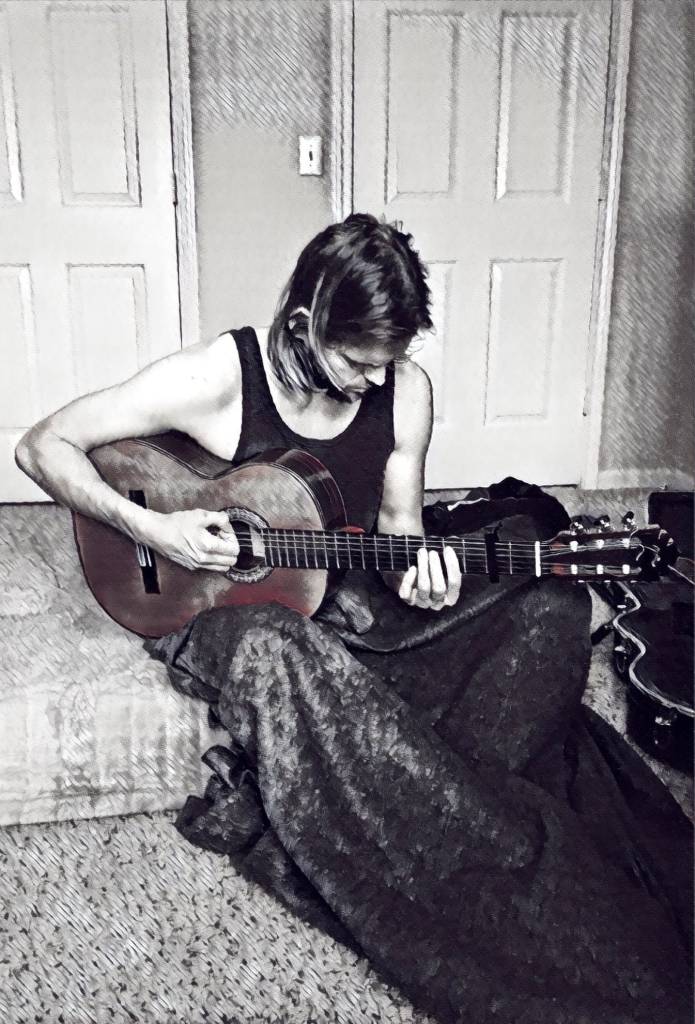
Soon I need to pack my backpack. I barely know the people who offered me a ride earlier—a much younger guitarist from my music school and his father. Yesterday I showed them my handmade luthier guitar. I wonder whose and what hands it’s in now? What a dumb question. It’s in my eighteen-year-old hands.
I watch as the father supports his son’s passion. There was—is—something deeply warm in the way they related. That warmth fills me now, along with the heat of that long-ago summer and my fierce, once-burning passion for music. For 143 seconds, the length of Victorsson, I’m thousands of miles away and hundreds of months ago. Am I there? Was I?
The song ends. I glance at my phone screen, and my attention catches on the word Victorsson. I suddenly realize: the younger guitarist’s father was named Victor. And that boy, years later, chose the alias Moo Latte. I’m one of his million listeners on Spotify. And I’m certain that none of them will find the emelic in Victorsson.

