
Someone once told me they don’t bother with names. If the bearer mattered, the name would remember itself. With that contemptuous pragmatism, their catalogue of names was surely sparse. I envied that—for a moment.
In my mind, alongside definite and indefinite articles, there are names—and with them, the faces and stories they belong to. They pile up with the natural course of life, arriving at a Poisson rate of new encounters.
I remember the names of the muleteers who led our group across the Pumahuancajasa Pass: the one without shoes, the one without teeth, and the one with seven children to feed. I remember the taxi driver’s name in Quito—the one who taught me the Spanish word ladrón: thief. I remember the name of the Tasmanian wanderer with whom I swam naked in the glacier-cold waters of Laguna Churup in Peru’s Cordillera Blanca.
I remember the names and faces of nearly everyone I’ve been introduced to, but I cannot match a name to the daughter of Marquito, a driver from Ecuador.
Some nights I try to assemble her name from letters scattered across the dark ceiling of my room, but none of them belong to her face. Chipped of her name, I sit down again to write my account of climbing Pasochoa, the volcano where Marquito and his daughter drove us. I look at my travel notebook, the narrative clear in my mind, the morals neatly forming, and yet I feel that without her name the story makes no sense—that I have no way to begin it. Tonight, I’m climbing Pasochoa yet again.
Marquito is visibly nervous. I soon learn that we are his first customers since he bought his car and began life as a self-employed driver. We throw our climbing bags, stuffed with gear, into the trunk and set off. He doesn’t use navigation, so I assume—wrongly—that he knows the region like the back of his hand. But I notice his daughter constantly trying to load maps on her phone. In these parts of Ecuador, there’s barely any signal. We have no navigation, yet the car radio screen pulses with the bright chaos of music videos.
The music videos in Marquito’s car.
I stop counting the dead dogs along the roadside. Traveling through various countries south of California, I’ve formed a hypothesis: the number of shoulder carcasses is inversely correlated with local GDP per capita. Marquito stops to use the oldest route-finding method—asking for directions. In a half-intelligible mix of Kichwa and Spanish, I catch that it’s not entirely clear where our hike should begin. “Do you want the harder or the easier trail?” Marquito asks. Of course we want the harder one. A foolish question at a foolish stage of our youth.
He tries to make up for lost time by racing over the ruts of an unpaved road. We bounce with the dancers on the radio screen. We reach the trailhead late and agree to meet in the same place in eight hours, the time suggested by the rangers guarding the national park around the volcano. His daughter climbs back into the car, and if you looked at me now in the glow of the laptop screen, you’d see a grimace of shame at not being able to name her.
The rangers are theatrically stern. They take our passport details, trace the route on a map, and point out that the trail ends at a vertical wall requiring climbing gear — one we should definitely not attempt. We must also be back to sign out by 5 p.m., which means we won’t be able to reach the summit of Pasochoa. Even though our goal is only acclimatization, “not reaching the summit” already feels like failure.
After several hours of steep ascent—through jungle and alpine meadows—we reach the wall. Along the way, we met Rosa and her companion, whose name I didn’t catch. She had pushed ahead, determined to reach the top, while her partner called after her, urging that they should turn back. Looking up at the wall, I jokingly ask if it’s their first date. La cita, the word I dig out of my Spanish vocabulary.
“With him? Never in my life,” she laughs.
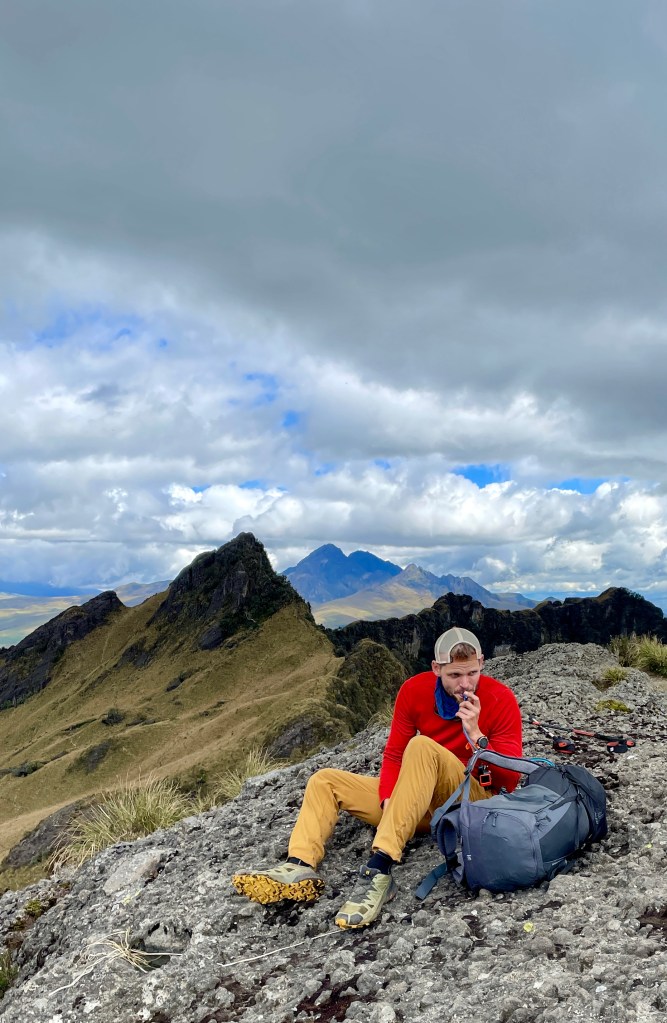
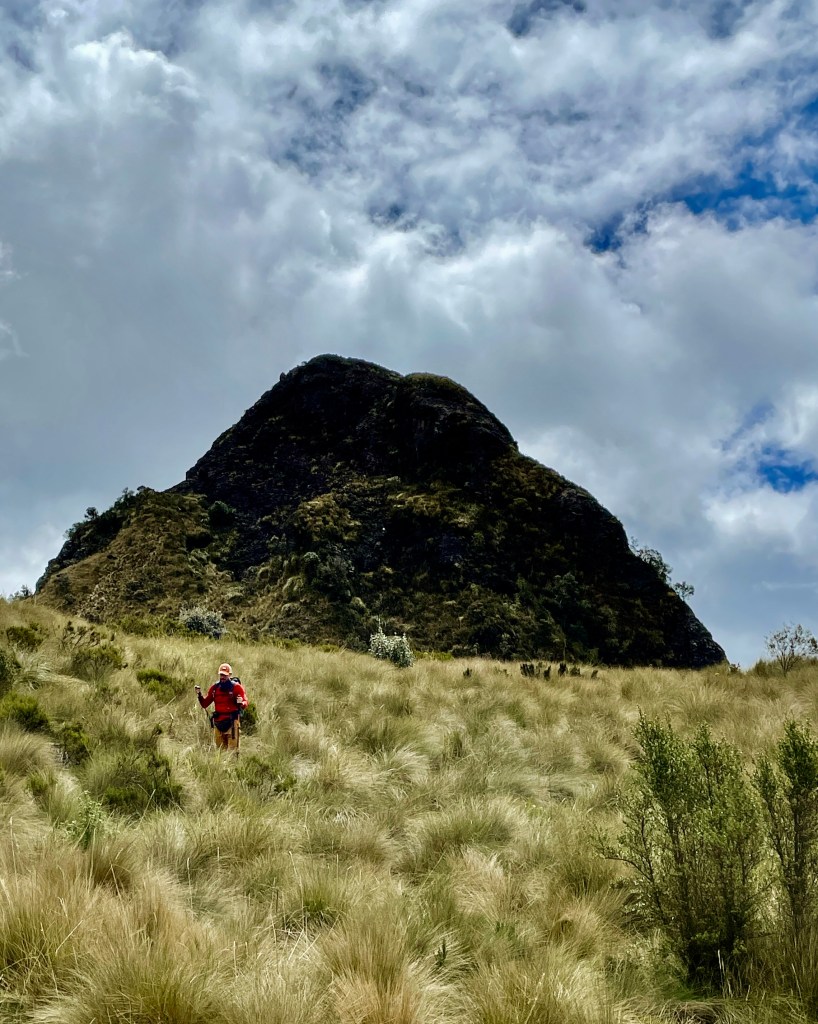
The wall before us would be a challenge, were it not for ropes tied to the shrubs sprouting from the rock. But time is against us; climbing further would mean returning after the park gates close. We remember from the satellite maps that there’s a network of roads on the volcano’s far side where Marquito could pick us up. I’m like Rosa’s friend now, urging my buddy to turn back. He insists we continue. I remind myself that every time he insists on something I have a bad feeling about, it turns into a good story. And so we begin the proper climb. Higher along the ridge, I manage to send Marquito a message with a new meeting point on the opposite side of the park.
The beginning of the climb.
Pasochoa is an old, extinct volcano that blew itself apart. Its crater collapsed on the northwest side, and the sediment created extraordinarily fertile conditions that sustain one of the best-preserved virgin Andean forests. Walking the ridge, the contrast between the lush and barren sides is striking. On the north summit, Rosa says she’ll turn back because her companion, waiting below, will be worried. She sits for a moment, drinking in the view of the clouds, the patchwork farmland, and the majestic cone of Cotopaxi. Beside her, a beautiful carunculated caracara perches on a stone.
“Maybe that should be your date,” I joke as we part.
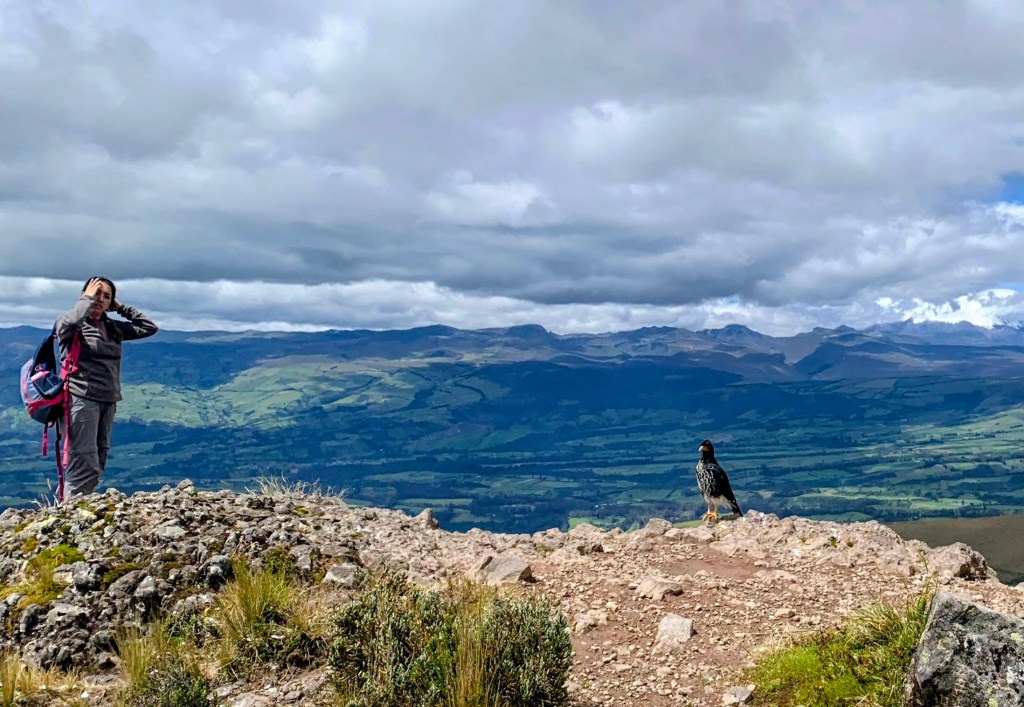
Rosa, caracara, and the glaciers of Cotopaxi (on the right edge of the photo, blending with clouds)
On the south summit, our water runs out. It’s a reason for concern, though I’m more worried about the lack of response from Marquito and the greying of the day, a sign the sun is nearing the horizon. From the summit we can see the road, so to save time we descend through tall grass, unconcerned by the absence of a marked trail. But when we reach the road, we realize the satellite images have deceived us; it would be difficult for Marquito to get here. We start moving faster, trying to reach a better road. Whenever I catch a crumb of signal, I send our location. Still no response.
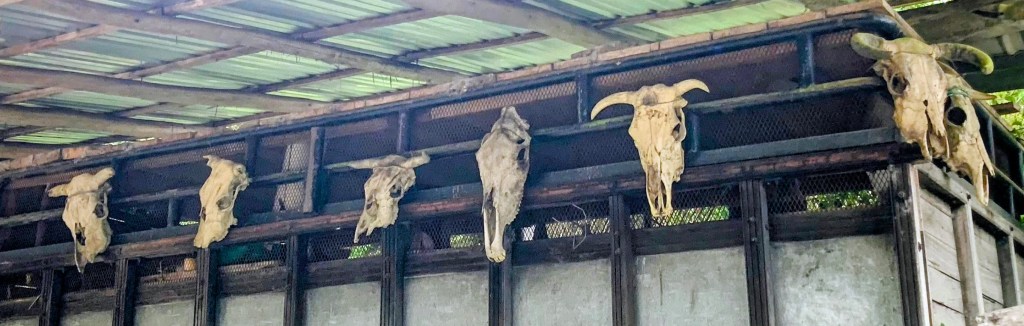
We pass an old ranch. Cattle skulls stare at us with the void of their missing eyes—ominously inviting. We’re clearly in a “civilized” area now, yet there are no people, no barking dogs. Just the skulls, and a caracara perched on a fence post. Is she following us? Do we already smell like carrion? I recall the dogs along the roads and picture myself among them. I must be getting delirious.
A message alert wakes me: Marquito is on the way. Relieved, I find more energy to continue. We descend further, but in the maze of dirt roads, he could easily miss us. We split up to make sure at least one of us will spot him. I’m alone now, jotting down some of the thoughts you’ve just read. I think about how thirsty I am. Then I remind myself—as I often try to—that on the spectrum of thirst humanity has endured and survived, mine must be negligible, an illusion at most, a dry throat. I feel better, and wait, and scribble.
Finally, I hear an engine down a steep road, but then it fades. I run after it and find Marquito stuck behind a locked gate. I thank him and his nameless daughter. I tell him I need to fetch my companion. Lighter, without my gear and my worry, I sprint back up the road.
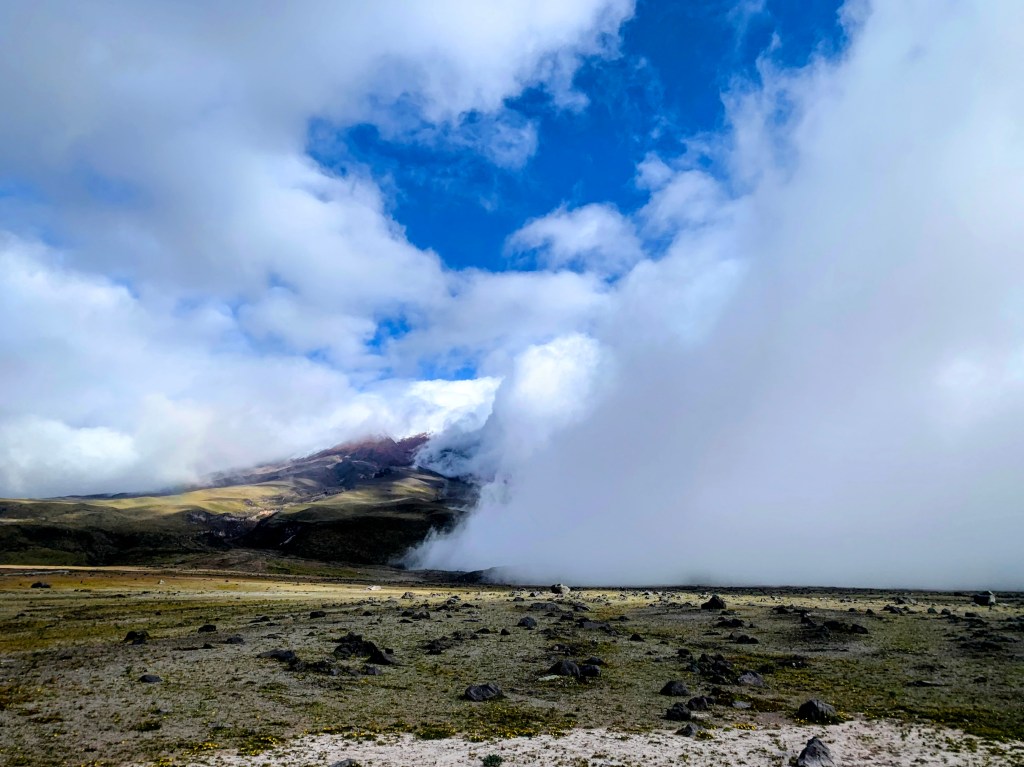
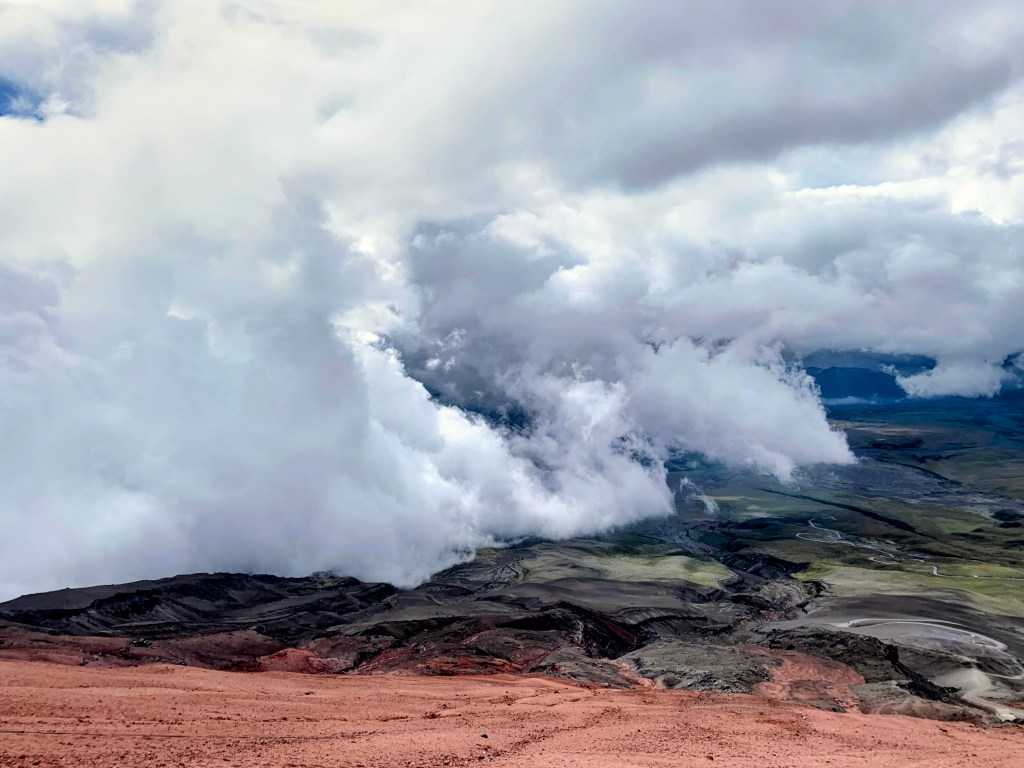
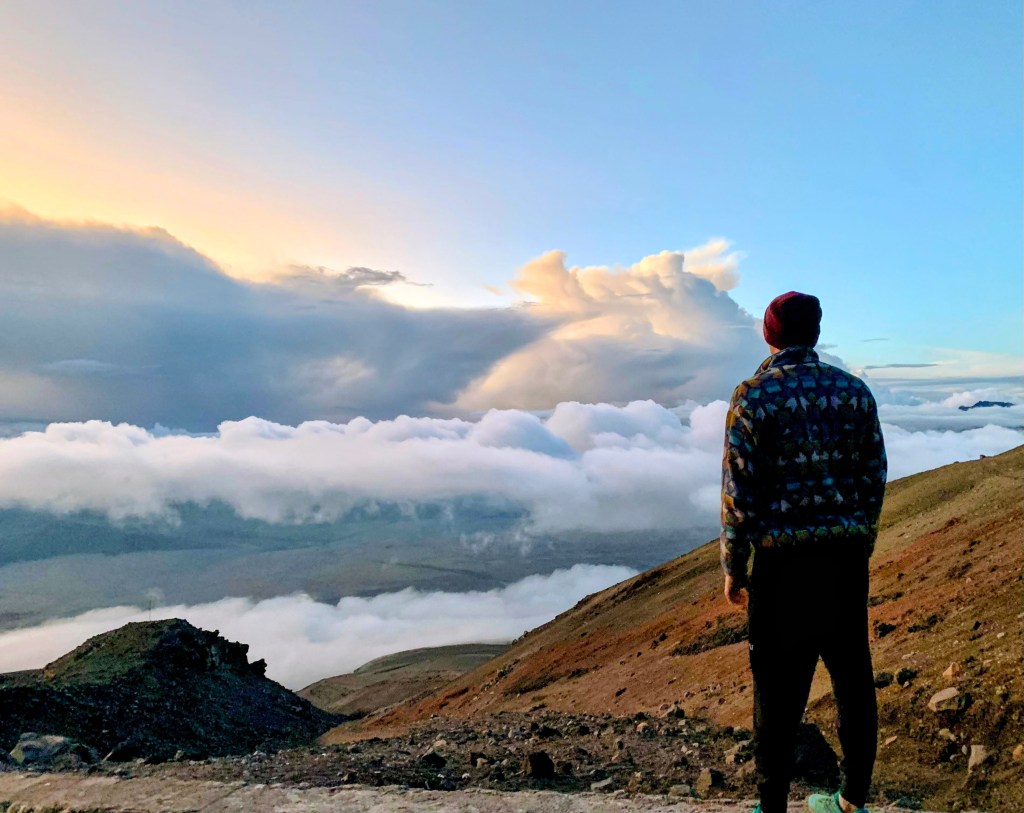
We’re in the car now, exhausted but relieved. Las montañas aquí, en Ecuador, son como las fábricas de las nubes, I say to Marquito, watching clouds grow from the slopes. They are extraordinary, those clouds. Spanish nubes, Polish chmury, English clouds. I write the last word and suddenly—like a cloud blown from a memory—her name shines through. Clouds! Claudia. Her name was Claudia.
There was, somewhere, an idea for a moral to this story. It was going somewhere, as we were to the summit of Pasochoa. But the summit was never the goal—it was acclimatization. And so this story will be like that: a hike into the cellars of mind palaces, only to uncover a name and gather the scattered letters from the dark ceiling of my room.
The Ecuadorian Cloud Factories
 Third Woods
Precioso como siempre
LikeLike