
Everything happens, nothing is remembered
in those dimensioned cabinets of glass
in which, like rabbis in fantastic stories,
we read the lines of text from right to left.
J. L. Borges, "Mirrors" (trans. Alastair Reid)
The Choreography of Intimidation
Which one took the first threatening step? It might have happened at exactly the same time. It was meant to be a mere warning, a bluff. But since the other one responded immediately, their fate is sealed by an escalating feedback loop. Eyes pinned to eyes, tendons loaded, fangs shining against black gums—an evolutionarily perfected choreography of intimidation. Oddly, though, when one snarls, the other replies with a silent grimace. As they close in, their pungent breaths combine into a wall of fog. Clawed paws pierce it, pads hitting each other in eerily synchronized parries. They try to rip out each other’s throats but their teeth bounce off slippery surfaces. Another strike, another miss. They read each other’s minds. They jump back and break off the fight.
The jaguar is terrified. He breathes heavily. So does his reflection. He lets out a parting growl and walks away, neither victorious nor defeated. Must fighting a mirror always end in a draw?
In a field variant of the famous mirror test, an ethologist left a big mirror in the middle of the jungle and filmed animals reacting to their reflections. The jaguar fails the cruel trial. He doesn’t recognize himself and fights his image. This is our anthropocentric interpretation. We, and a few other species, are much smarter. We quickly realize the correspondence between the reflection and the reflected, and ignore the mirror. Or, more often, flex a muscle, fix the fringe, pet the ego, or spit in its face.
The Claiming of Self
Are we much smarter? What if we are the ones who fail the mirror test?
Why don’t we remember the discovery of the mirror? Isn’t that the key moment in our lives? The moment we claim the ego. The moment we plant the flag of self in the no man’s land of unique brain activity. To look at the reflection, call it “I” and… forget that?
The reason this appropriation never registers as a singular event may be simple. It could happen long before we acquire the conceptual toolkit to label it “pivotal.” We inhabit an empty land because the not-yet-existing self needs land to settle. Only later, with some acquired conceptual sophistication, do we realize that this land is everything there is. Or maybe we claim the ego gradually and never have the “aha” moment. A dimmer brings up the light so slowly that each step stays below the just-noticeable difference. The self emerges like dawn from darkness. Either way, in our history with mirrors, there are no fireworks, no awe, and no… terror.
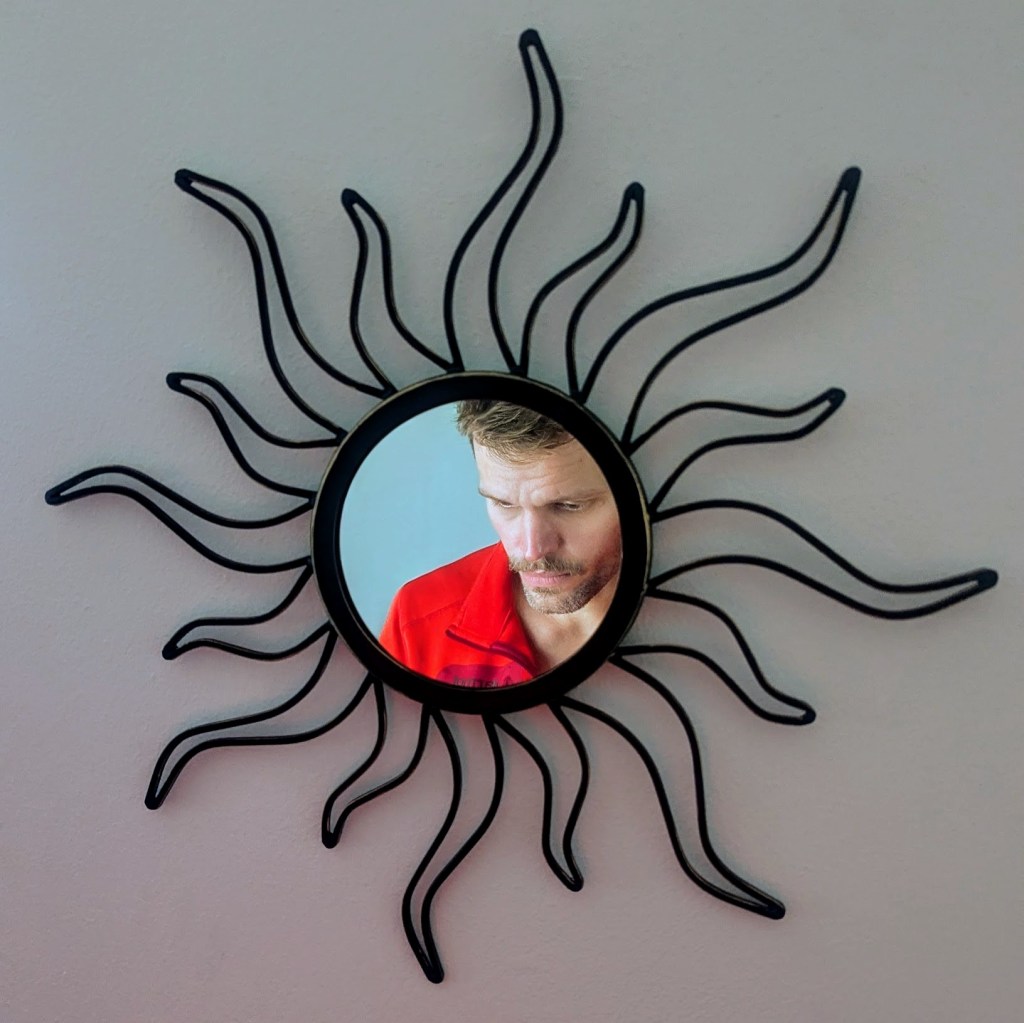
For isn’t it terrifying to discover the self and, at the same time, to witness it multiplied? Isn’t that what the mirror does? Maybe the jaguar realizes this immediately and attacks the usurper? Maybe we fail the mirror test by not doing so?
The Cephalic Vein
The cephalic vein collects blood from the back of the hand and surfaces on the arm to dissipate heat. If one is lean, one can see it in all its venous glory, climbing the outside of the biceps. It can look impressive if one is obsessed with dumbbell curls and one’s sleeveless image, but otherwise it’s rather dispensable and the body would be fine without it. A vain vein in vain.
I settle the barbell low on my upper back, the knurling grating my skin, and let it sink further, into a range just short of discomfort. I push my rotator cuffs to their structural limits. Then I press. If I were a jaguar, my shoulder blades would float freely, but I am breaking the rules of evolutionary biomechanics and must tune into signals from the joints and muscles. Everything seems to be in the right place, but something is missing. I’ve been in this new gym for a couple of hours and only now do I realize there are no mirrors. Without them, the cephalic vein—my vanity token—cannot reveal its path on top of the stretched front deltoid. It feels incomplete to lift without the narcissistic feedback, but I press on.
The Reclamation of Oneness
Mirrors and copulation are abominable, since they both multiply the number of men
J. L. Borges, "Tlön, Uqbar, Orbis Tertius"
I am back in my old gym. We are back. Multiplied by a hundred mirrors, we look at ourselves from every direction. It’s been a while and we’re surprised at how time and training have retouched our body. Hamstrings clearly separated from the quads, veins branching on the lats. Detailing.
We are in the middle of a set of push-ups. Neck craned unnaturally to stare at the mirror and watch the cephalic veins vanishing under the pumped pecs. Eyes pinned to eyes, tendons loaded, teeth shining against pink gums. We have a few more repetitions left, when suddenly liquid gold spills from the irides. Black ink diffuses through the exposed gums. White fangs grow.
Once, a long time ago, on the edge of a jungle cliff, I met a jaguar. I looked into “los ojos del gato, the eyes of the cat.” We stared at each other in awe and terror. When we recognized ourselves in each other, we disappeared. We abandoned the land we had inhabited for years. But then, slowly, below the just-noticeable difference, the self emerged again, like dawn from darkness. And the land of “I” had been reclaimed. Now, years later, surrounded by iron instead of wood, we gaze again into los ojos del gato.
Our neck hurts. How long have we been staring at ourselves holding the plank position? We notice someone in front of us, holding the plank as well, sweat dripping onto the floor. We are about to take the first threatening step—a mere warning, a bluff—but then the other one drops to the floor and rolls onto his back.
I look at the ceiling for a bit and then sit cross-legged and victorious. Fighting a mirror doesn’t have to end in a draw. I scan the room, counting people trapped in mirrors, trapped in their phones, taking selfies and recording from tripods. There is no judgment in this survey, but I realize I cannot afford multiplication. I cannot afford to scatter my copies—capable of nothing but mimicry. I begin my next set of push-ups, eyes fixed on the floor.
I count repetitions, and somewhere between twin primes I recall two poems from the Platform Sutra of the Sixth Patriarch, a classic Buddhist text.[1] The first one, attributed to Shen Xiu:
Our body is the Bodhi-tree,
And our mind a mirror bright.
Carefully we wipe them hour by hour,
And let no dust alight.
The second poem, attributed to Hui Neng:
There is no Bodhi-tree,
Nor stand of a mirror bright.
Since all is Void,
Where can the dust alight?
The sweat on the floor under my body turns into dust.
- Translated by A. F. Price and Wong Mou-lam.↩︎

