
I once saw a kite festival
from a train, lost somewhere in Mexico.
That’s all!
(in both senses)
Lads, are ye from far away? See, ah’ve nivver bin onywhere. Ah only went wanst in ma life tae Sieradz, by train, for ma wee cousin’s weddin’—aye, that’ll be aboot sixty year ago, or even mair, if it’s no better. Ah mind, it was flat there, like a table, no a single wee hillock. An’ is it that flat where yer from? ‘Cause ah was born right here at hame, an’ ah’ll die right here at hame. Durin’ the war, the Germans, the officers, they billeted themselves wi’ us. The whole room taken up, an’ we wur squeezed intae the shed, which is no’ even there noo. Ah mind, wan bonnie lad, he gave us sweeties. An’ then, when the Russians cam’, that was a fright. Noo, they’ve just put up these pizza places, right under wir nose, an’ a body can just sit doon, have a blether. On the telly, ye see everything, they say—but ah, ah’d rather look oot here, oot the window, an’ have a blether wi’ some livin’ soul.
I am a living soul. I sit at a table, flat like the fields on the road to Sieradz. A woman sits in the window. For eighty years, she’s been watching the courtyard from the compartment of her room. The train of her house stands in apparent stillness, yet the world beyond the window keeps changing. I keep listening.
The apple tree over there bore thousands of apples and died. They were usually sour. One autumn, unexpectedly, they turned sweet. Old Cabała broke the tree with his tractor—but it had to be done. She was old. That tree. Another neighbor bought the first car in the village, then died in a crash. He drank too much. There is no neighbor now. No children either. They grew up and left for the cities in the natural rhythm of progress. A few didn’t make it that far. They died of scarlet fever or some other devilry. Two drowned in the river—the same river I’ll be kayaking this year with my father. Now there’s a pizzeria in that courtyard, and things get lively. Especially when people drink. Especially when people drink…
That old woman returns to the window of my memory after twenty years of absence. It may be the only window she’s appeared in for years. With biological certainty, she no longer appears in the one overlooking that courtyard.
I sit on a fence near Nobska lighthouse on Cape Cod. The sun cuts through a small cove with its first beam of light. The world appears still, but if you look closely, the landscape pulses—flickers with constant change. I think of that courtyard, slow-pulsing for decades. I wonder if that woman ever saw a sunrise. In the valley where she lived, the sun wouldn’t rise above the mountains until late morning.
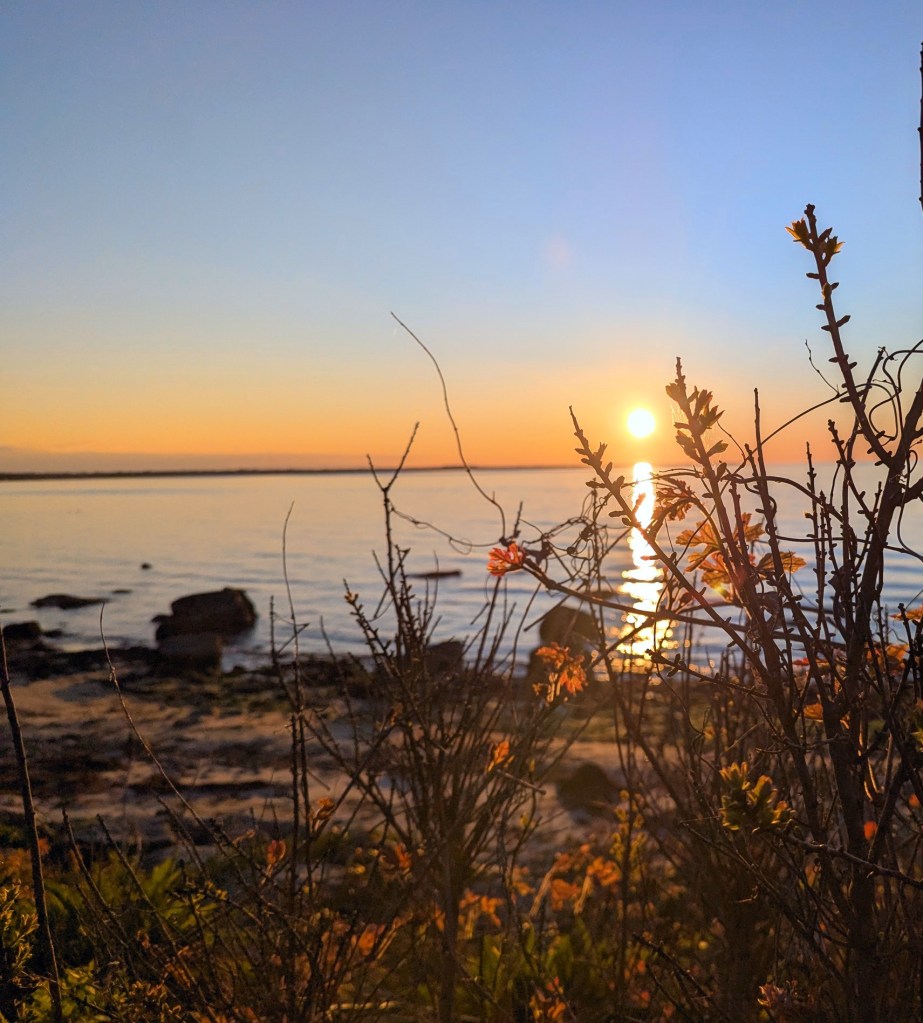
I think of all the sunrises I’ve seen—from the peaks of the Andes, from the deserts of North America, the Scottish moors, the open sea, the windows of skyscrapers. Twenty years ago, I hadn’t been to any of those places. And still, I remember feeling a quiet superiority, maybe even pity, for her. I believed there was an ocean of experience separating us.
Now, having learned the uniqueness of years and sunrises, it’s clear to me that across the ocean of all possible experience, each of us—that woman, myself, and the globe-trotter we envy for their next expedition—drift in fish bowls that differ only slightly in size.
Drifting across the ocean of thoughts about the ocean of experience, the ocean before me shifts its hue from early to late dawn. From my headphones, music spills in from other places and other times: the throat singing khoomei from distant Tuva, Allegri’s Miserere from the distant Renaissance. It’s incredible to live in a time where, while being in New England, I can take such a musical journey through history and cultures.
Fauxbourdon, the “false bass” harmonization in Miserere, reminds me of la quintina—the illusion of a fifth voice in the traditional shepherd songs of Sardinia. I encountered that phenomenon for the first time just days ago, and the fact that I, a musician, had never heard of it before reminds me of the infinite list of phenomena, objects, places, and histories I haven’t encountered—and never will.
That enormous difference in scale—between what has been experienced and what is potentially experienceable—has begun to stir in me a distinct kind of emotion. One that might deserve its own definition.
tyleph (n.) (pronounced: tuh-leph)
from Polish tyle (“so much” or “only that”, depending on context) and Aleph—the point in Borges’ story from which all places in the world can be seen, simultaneously and without confusion
The awareness of the disproportion between the richness of reality and the narrow aperture of human perception—its limited capacity, bound by time, space, lifespan, and by the mind’s own constraints. A realization that there is so much to see, to feel, to understand—and yet only a fraction can ever be witnessed or grasped.
I look at the ocean. Flat, like the fields on the road to Sieradz. I know this because someone once told me. I’ve never been to Sieradz. I smile, realizing that, and walk on.
A Smile
by Antoni Słonimski (translation by JG)
How good it was, to lie among the brambles,
At noon, with books, in garden’s soothing shade
How good it’s now, with engine’s teasing gambols
To flee through Paris, onwards, unafraid
How good it was, to watch the globe’s slow turning
And hold the world in one familiar room
How good it’s now, to quench the wild heart’s yearning
With breathing steppe under the night sky bloom
How good it was, to live and let things be
In ma’s old house, where all the things felt near
How good it’s now, to sail across the sea
And land with ease upon the sunlit pier
How good it was to circle in a restless glide
The fragrant secrets in the crystal ball
How good it’s now, to have that choice inside
To end it with the pistol’s final call


Nice
LikeLiked by 1 person