
The boy at the next table has almost outgrown the proportions of an infant. Almost. Only a slightly oversized head betrays his short tenure among the born. A ray of gel sheen wanders across the dark cover of his hair to the rhythm of the lamp swaying from the ceiling. The hair gives the boy a grotesque gravitas. The anointing with gel is a rite of initiation; it proclaims that he has outgrown the proportions of an infant.
The boy won’t stop talking, addressing his mother in round Spanish sentences.
A sudden silence lifts my head from my plate. The boy has gagged himself with his mother’s breast. The place where an Adam’s apple will one day ripen pulses rhythmically; his eyes are half closed. I had been overexposed to this frame. As a child I would sneak up to the attic to leaf through an album by the Czech photographer Jan Saudek. The nursing woman is one of the recurring motifs in his photographs. Back then I took in the naturalistic nudity with fascination and guilt. Now I live through a similar emotional déjà vu, though this time what dominates is fascination, nursed on contradiction.
“Either hair gel or mother’s milk,” I think. “Not both. Together, they’re unbecoming.”
We are waiting out the heat in a joint typical of the area. Pieced together from a few garages, add-ons upon add-ons, barbed wire braided with Christmas lights. In a summer that comes in December, the wire and the lights are a bit like gel and mother’s milk.
Hoping for distraction, I turn my eyes toward the shop, separated from the joint by heavy bars. A worn-out industrial fan turns sluggishly in the scalding air. Too slow to chase off the flies, but they can’t even be bothered to land. Candy sags on the counters, keeping up appearances only thanks to faded wrappers. I feel much the same, keeping up appearances only thanks to a faded shirt and a glass of cold Imperial.
My companion’s phone buzzes on the table.
“Hallo Mama, wie fühlt sich Papa heute?” he says into the phone, his voice anxious.
A man sitting a few tables over straightens up unnaturally. Perhaps some fly finally deigned to land and he shook it off like an irritated quadruped. He waits for the call to end and treads over to us on bare soles. Above him hangs a repulsive, ugly-brown aura of enlightenment. It is the color of his feet and of the makeshift asbestos-cement roof, contrasting with his pale scalp. Before opening his mouth, he opens his third eye. I trade glances with it. It is bloodshot and ringed with false eyelashes.
The newcomer strikes up a conversation with me in German. Realizing I don’t catch everything, he switches to Spanish. My companion breaks off his call and introduces me as “el polaco californiano aventurero.” This time the man addresses me in fluent Polish, almost without an accent. Almost. The nuances betray his native German.
“For many years I had an architecture firm in Warsaw. But I grew weary of the Western formula and decided to teach holistic architecture in Costa Rica,” he says, explaining both his fluent Polish and his presence in the jungle. He would have impressed me, if not for the ostentatiously humble superiority in the gaze of his third eye.
Holistically enlightened immigrants are a species of their own, one among thousands in biodiverse Costa Rica. Some place them in the genus crunchy granola, and perhaps that is the most fitting taxon for them. Boys and girls. Ripe and overripe. They drift along the roadsides, mutely hoping for a ride to the nearest crossroads, bus stop, bar. Sometimes naked and often beautiful. Even so, in their strange absence, they are impossible to desire. Holistically enlightened immigrants. Classification is one of the hardest subjects in science, because in many cases it has to be arbitrary.
The architect slides his business card across the table to me. Its sharp edge sweeps up flecks of asbestos sifting down onto our heads like Christmas snow. Barbed wire for lights, asbestos for snow. Christmas under the Tropic of Cancer. There is a name on the card. Against my nature, I don’t place it in my memory. Why would I, when I have the card. And unlike memory, I can lose it.
The architect leaves. I follow him with my eyes. Leaving the shade of the asbestos roof, he lifts his toes and scuttles clumsily across the hot gravel on his heels alone. I tilt my head in surprise. I had expected the architect to cross the scorching ground unmoved, like a Sufi mystic over coals.
My eye, like a skilled cinematographer’s lens, shifts its focal length and sharpens the foreground. The boy sleeps. The leftover milk trickles from the corners of his mouth and meets on the rise of his chin. The flies deem this a good enough reason to land. His mother doesn’t notice, staring glassy-eyed at her phone.
A waitress comes to our table. She collects the glasses. Her eyes brim. In a voice that trembles like glass knocking against glass, she asks if we need anything else. My companion and I both catch the tremor. I open my mouth in a question mute for lack of foreign words. My companion has plenty of them, but uses few.
“¿Todo bien?” he asks, in a voice lined with pure care.
The waitress breaks into sobs. She tells us her brother crashed his motorcycle in San José and she doesn’t know what to do. Her cheeks are black with tears. The black stains my companion’s shirt as he hugs her, a reflex as involuntary as the tears running from my own eyes.
“Todo va a estar bien,” he says, in a voice lined with pure care.
He says it in a way that makes me believe. He slips her a few bills for the trip to the capital, to visit her brother in the hospital. She sobs even harder. I tear my eyes away from the scene and notice that the ugly-brown aura the architect left behind has turned saffron-blue. I place their saffron-blue names in my memory, hers and her brother’s. She disappears into the kitchen, and the scene comes to an end. No business cards, no bare soles. Only bare souls.
I enter the lesson from that joint in San Salvador de Barú into my register of enlightenments: don’t hand out business cards, hand out hope. I write it in saffron-blue crayon and decorate it with a flowery border. We step out into the sun. The sand scalds my bare feet. On my way out I always check that nothing’s been left behind, so I run back to the table on my heels. In my self-satisfaction I hadn’t noticed the false eyelash falling onto the table in front of me. In the meantime, the worn-out industrial fan has blown it away somewhere.
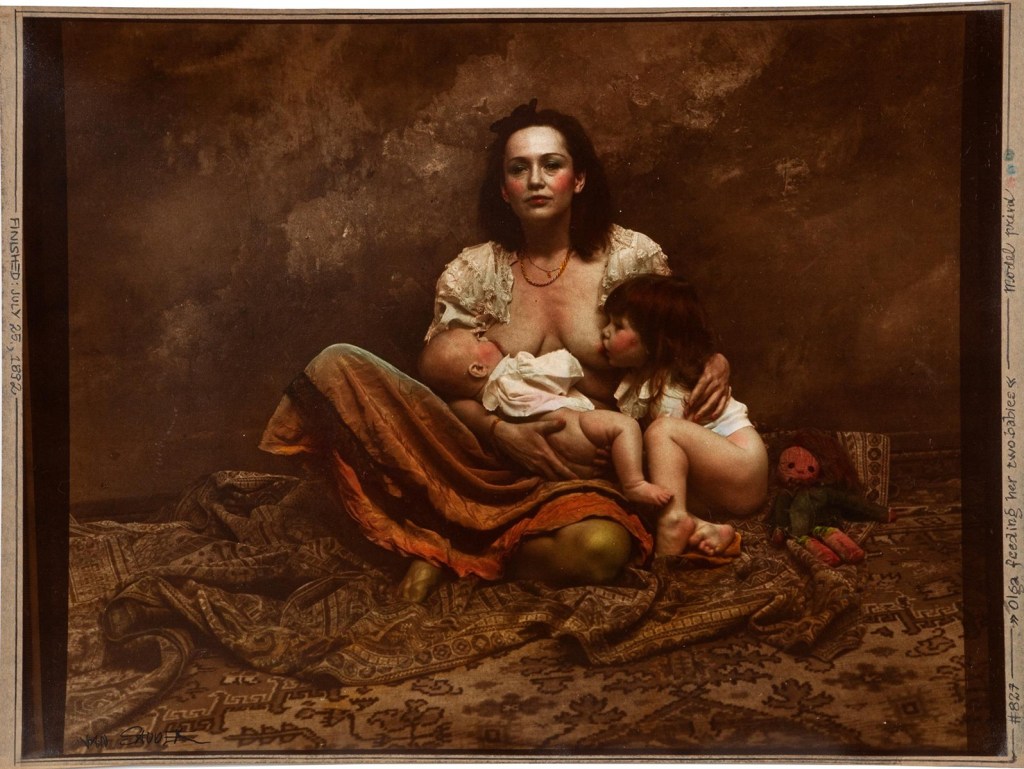
Jan Saudek, “Olga feeding her two babies”

