
Illiniza Norte syndrome (n.): a condition of the multilingual mind in which acquired languages, instead of adding to the native one, tangle with it. Thoughts in the mother tongue slow down and become clumsy, while the new language, however well mastered, is still not accepted as one's own.
(from Illiniza, Kunza for "masculine hill," and Spanish norte, north; itself a multilingual hybrid)
In Kunza, an Andean language, Illiniza is a masculine volcano. Or so I’ve read. There is no one left to ask: both the language and the volcano are extinct. Its spirit, its apu, turns out to be alive, and it is eager to answer. As we leave the saddle between the southern and northern Illinizas, the apu tests our manhood with a gale.
Open space sealed by dense cloud and pressing wind can feel intimate or claustrophobic, depending on one’s mood. Right now it feels cozy, so I must be in high spirits, or at least in the company of one. The feeling doesn’t last. The path in front of us begins climbing an ominous, cloud-splitting blade of ridge. I am hoping we skirt it on the leeward side. Instead, the path follows the crest, then descends a bit on the windward side. Paradoxically, the wind I feared now pins us to the basalt wall, and we step more confidently over a chasm cushioned with cloud.
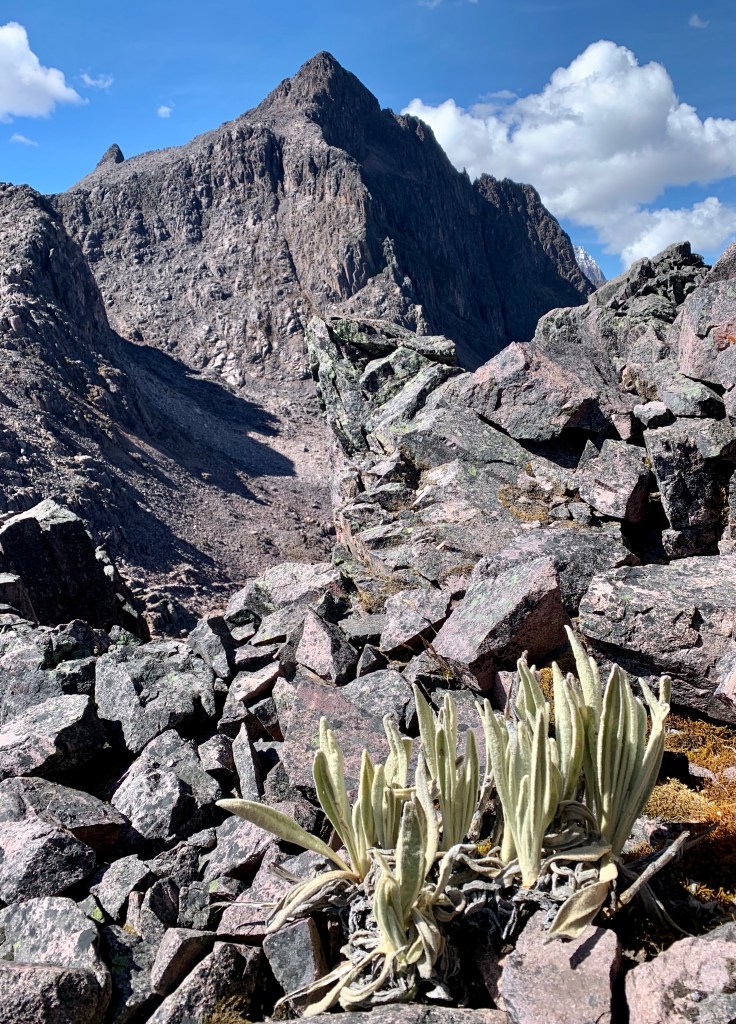
Like a Maxwell’s demon, the wind sifts water droplets out of the sea of clouds, petrifying them in rock crevices and in our itinerant stubble. After a few minutes, our faces are covered with a layer of ice. Before our eyes, icy structures bloom from the rocks. I have seen hard rime feathered horizontally on lonely summit trees, but never spikes shooting skyward like these. How the wind manages it against these slopes, I can’t work out, but the crystals sprout upward like leaves of rimy shrubs. They look like the wira-wira I saw in the Peruvian Andes. The convergence is striking. Nature rhymes, and here, quite literally, it rimes.
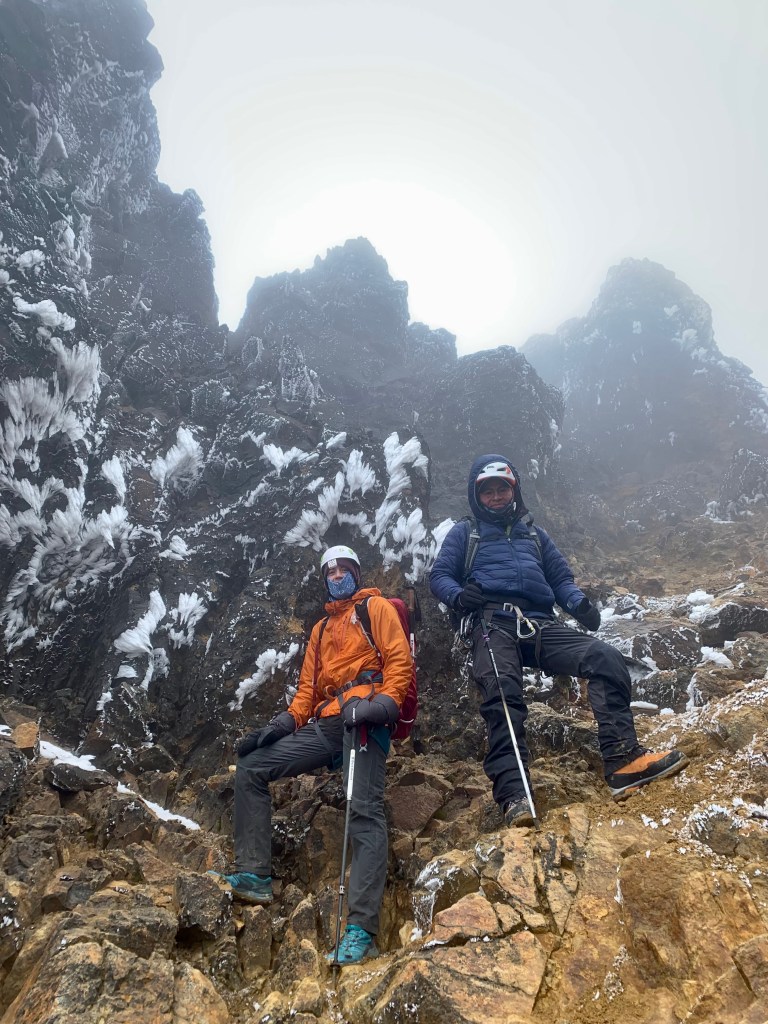
We are exposed again. The wind plays the jagged ridge like a giant harmonica. Is it a siren song? Or maybe the apu‘s? Our guide suddenly stops, screaming “¡Aquí es!” through the howl. We look around, puzzled. The fog distorts any sense of space; we might as well be standing on a rocky mound. Have we just reached the summit in the most anticlimactic way? A metal cross wedged in a rock confirms it. At least we have passed the test of Illiniza’s apu. The wind softens, allowing for congratulatory hugs and trophy photos.
We begin the descent on a different, easier route. Protected from the elements, we have our first chance to chat with our guide Fabian. He is from the Kichwa people and grew up speaking their language. He learned Spanish, which we are speaking now, in school. He teaches us a few basic Kichwa words, briefs us on the itinerary, and tells us some anecdotes. After a moment of silence we split, each moving at our own pace. Fabian walks in front, navigating on autopilot, nonchalantly checking his phone. My companion Luc, raised in the mountains of Montana, follows him closely. I, the heaviest of us, fall behind, sinking in the loose volcanic dust.
A vast, hay-hued llano seeps through the cloud like watercolor bleeding through to the back of the page. The perfect cone of the Cotopaxi volcano punctuates the horizon. Yet I don’t really see it. Thousands of cautious steps have put me in a trance. I am somewhere else.
I learned a large part of my Spanish from a language app, and its interface now hovers in my visual field. Holographic signs with Spanish phrases appear and disappear in a hallucinatory reel. My oxygen-hungry brain replays the recent conversation with Fabian. Suddenly, one of the virtual tiles turns red, indicating a mistake. I said “varias idiomas extranjeras“—several foreign languages. ¡El idioma! A masculine noun ending in an “a.” A trap word: my tired, fast-spoken Spanish took the bait and paired it with feminine adjectives. Polish is a gendered language too, so I can feel what the mistake must have sounded like.
As I walk down a naturally formed stone staircase, my delayed autocorrect strikes me as a bona fide esprit de l’escalier—literally, the spirit of the staircase, which hands you the right words only when it’s too late to use them. Illiniza, it seems, has more than one spirit. I am amused by this Latin-French observation, but it only makes sense in English, where bona fide means “genuine.” In Polish, where it means “in good faith,” the phrase makes no sense. For the peace of my purist mind, I swap the Latin for French: l’esprit de l’escalier par excellence.
I look back at the mountain of babel, towering over the cirque we have just descended. I see our group from half an hour ago. There I am, thinking mostly in Polish, speaking Spanish with a Kichwa-thinking guide, and translating the sentences into Luc’s native English. In that chain of three minds, each of Fabian’s sentences passes through Kichwa, Spanish, Polish, and English. Luc’s replies go in the opposite direction. I am convinced that Fabian, who learned Spanish as a child, does not translate the way I do. But then, by now, neither do I translate everything from Polish. Many sentences surface directly in English, or the translation happens somewhere my consciousness can’t watch. Perhaps the thoughts beneath them still begin in Polish, only sealed in dense cloud.
I look away from the summit and peer into the babel of myself. There is a certain superpower in knowing a foreign language, a key to other cultures, to other souls. However, there is also a kind of ill, a collection of ills, a syndrome that progresses with mastery, and with every year spent inside a language’s soundscape. The new language begins to master its would-be master. Native words fade away, native syntax breaks down. Thoughts in the mother tongue—once quick and agile and graceful—now walk awkwardly, as if through loose volcanic dust and thin air. It would not be so bad if the newly acquired languages took over the impetus and agility of the old one. Instead, they tangle, and thoughts turn slow and clumsy.
Is it inevitable? Some writers have acclimatized to a foreign language so fully that they wrote their best work in it. Nabokov did, and so did Conrad, a Pole. Neither seems to have suffered the syndrome I call Illiniza Norte. I am nowhere near their acclimatization, and in all my languages I feel the altitude. Illiniza Norte, a hybrid of Kunza and Spanish, is a fitting name for that condition.
Winds on Illiniza Norte (Ecuador) and on the cliffs of Isle of Skye (Inner Hebrides, Scotland)

